The great financial convergence towards regulated tokenisation: Visa’s entry and the focus on real assets
By Antonio Tejeda Encinas CEO META Channel Corporation
Continuing with the analysis of the article “BlackRock forces the norm and how Europe—from MiCA—offers the legal response“ (published on November 4, 2025), which explored how giants like BlackRock are positioned at the center of tokenization before regulation is fully consolidated, promoting its creation and ensuring presence when the regulations arrive, this text delves into that dynamic.
Breaking news: today, 10 November 2025, the Bank of England (BoE) has launched a landmark consultation on systemic sterling stablecoins. It would allow up to 60% of reserves to be held in short-term government debt, give access to BoE accounts to support solvency, and set temporary holding limits (£20,000 for individuals, £10M for businesses) that would be phased out. Like the GENIUS Act in the US, it is a move that forces the regulators’ hand with Anglo-Saxon boldness — while in Europe MiCA already offers absolute regulatory certainty for tokenised real assets, without speculation.
Now, with Visa’s recent move into the on-chain ecosystem — stepping up its commitment to stablecoins and tokenised lending in October 2025 — we can see that everyone wants a piece of blockchain, a field that for META Channel Corporation is already natural, everyday ground.
All these players are innovating boldly in their specific roles (sometimes at the edges of regulation, as if anticipating frameworks such as the GENIUS Act in the US), but META Channel Corporation stays within the absolute certainty of MiCA, focusing exclusively on tokenised real assets, without speculation.
This approach sets us apart: we do not compete on global scale, but on the end-to-end design of legal and technological processes for clients who want to tokenise with full regulatory certainty.
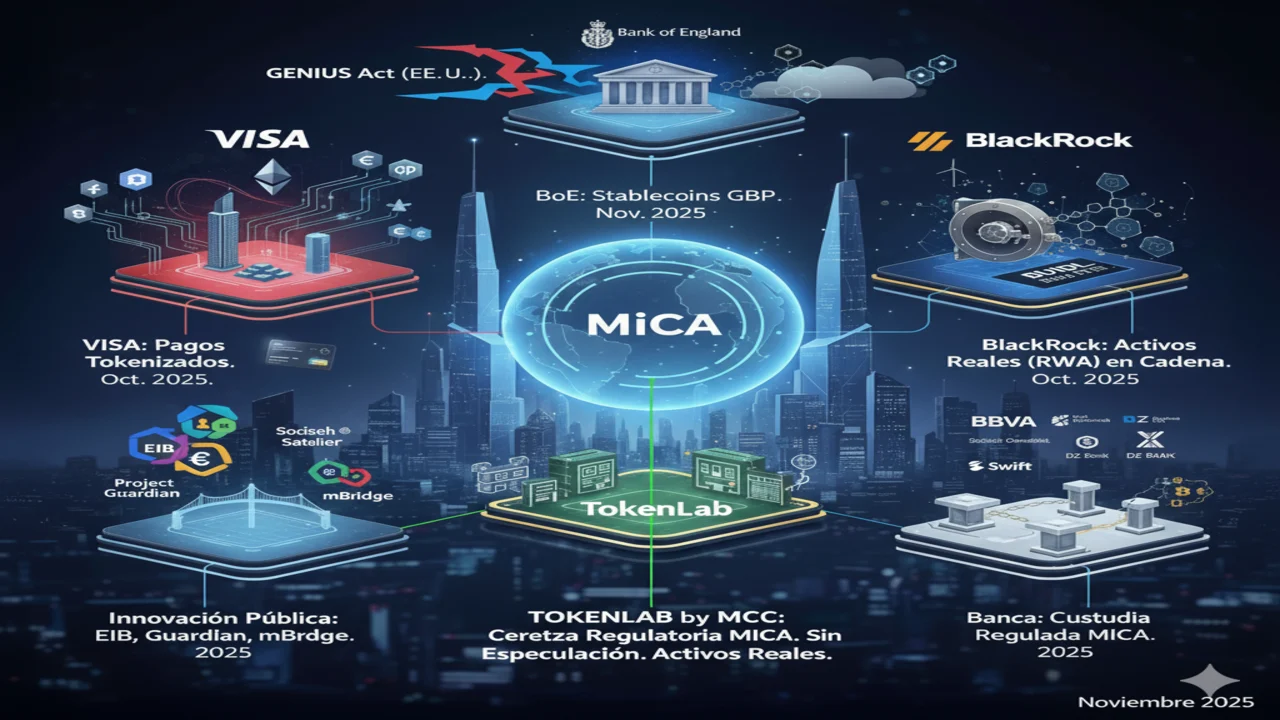
Below, we update the picture with key moves from November 2025 — including the BoE’s bold step today — showing how each player innovates in its role: how far they go with pre-regulatory boldness, and how META Channel already operates on that horizon with post-MiCA precision.
And while all these players innovate boldly in their roles, a key question arises — the same one we raised in the previous article: who ensures that this convergence works with absolute regulatory certainty, without speculation?
Tokenised payments: Visa forces the regulators’ hand on settlement and cross-border payments
IN ITS ROLE AS A LEADER IN GLOBAL PAYMENTS INFRASTRUCTURE, Visa took a decisive step in October 2025, consolidating its position as a bridge between traditional and on-chain finance through stablecoins. Following its announcement of 28 October, the network now supports four new stablecoins — USDC, EURC, PYUSD and USDG — on four additional blockchains (Ethereum, Solana, Stellar and Avalanche), enabling instant cross-border settlement convertible into more than 25 fiat currencies.
An earlier Visa report, dated 16 October, notes that stablecoin lending has exceeded $670 billion over five years, with $51.7 billion in August 2025 alone, driven by smart contracts that automate credit markets 24/7.
CEO Ryan McInerney described it as part of Visa’s transformation into a payments “hyperscaler”, with tokenisation and stablecoins as pillars, and volumes quadrupling in Q4 2025 (annualised at $2.5B a month). This includes pilots with issuers such as Circle to mint and burn bank stablecoins via the Visa Tokenized Asset Platform (VTAP), in line with Citi and Coinbase projections of a $4 trillion on-chain market by 2030.
Visa, with its network of more than 15,000 institutions, arrives with massive scale in its settlement role, but is still in a phase of aggressive experimentation — driving the ecosystem forward before regulations such as the GENIUS Act (signed in July 2025 and taking effect in November 2026) fully apply, much as BlackRock forces the regulators’ hand in asset management.
In Europe, Société Générale, in its role as a regulated bank issuer, integrated its EURCV stablecoin (launched in 2023) into DeFi platforms such as Morpho in October 2025, under MiCA, with 100% euro backing and BNY Mellon as custodian for variants such as USDCV. This shows how systemic banks are moving forward on instant payments with regulatory certainty — an area where Visa is only now stepping up its innovation.
Real assets on-chain: BlackRock scales up in RWA and ETF management
IN ITS ROLE AS A GIANT ASSET MANAGER, BlackRock reiterates that the tokenisation of real assets (RWA) is inevitable, with Larry Fink stating on CNBC on 14 October 2025 that more than $4 trillion held in digital wallets is ready to migrate.
Its BUIDL fund, launched in March 2024 and tokenised by Securitize, passed $1 billion in AUM in March 2025 (56% monthly growth), expanding to Avalanche and Aptos with daily yields and DeFi adoption (e.g. Ethena’s $200M allocation). BlackRock is preparing a GENIUS Act-compliant money market fund for stablecoin issuers, a move that, as discussed in the previous article, places the asset manager at the centre of RWA before regulation tightens, ensuring that its model (with more than $70M in yields distributed) becomes the benchmark when the regulatory framework arrives.
In Spain, @Azvalor, in its role as an innovative local manager, launched its Azvalor Blockchain FI on 6 October 2025 under the CNMV sandbox, with real-time settlement via Allfunds Blockchain and BNP Paribas as depositary. This tokenised UCITS fund illustrates the maturity of European RWA, aligned with MiCA and focused on efficiency without speculation, similar to Franklin Templeton’s fund management initiatives.
Banking reinvents itself: BBVA advances in custody and retail services under MiCA
IN ITS ROLE AS A GLOBAL BANK WITH A FOCUS ON INSTITUTIONAL CUSTODY, BBVA scaled up its crypto offering in 2025 with an emphasis on regulation. In September it signed an agreement with Ripple for digital custody in Spain, building on its presence in Switzerland (since 2021), and in the same month launched BTC and ETH trading and custody for retail clients, all under MiCA.
This brings blockchain together with Swift in its custodial role, strengthening security for real assets, as Francisco Maroto emphasised: solutions built to “banking standards” to avoid speculative risk, innovating at the edges of an already consolidated MiCA.
DZ Bank, as a cooperative custodian in Germany, rolled out its platform with Ripple in January 2025, having started retail pilots with Börse Stuttgart in December 2024. These steps show how banks are taking their custodian role on-chain, spurred by MiCA, but still implementing it gradually given past volatility.
Public innovation and global collaboration: EIB, Project Guardian and mBridge accelerate sovereign infrastructure
IN ITS ROLE AS A SOVEREIGN ISSUER, the European Investment Bank (EIB) issued its fifth digital bond, worth €100 million, on 15 November 2024, settled with Bank of France wholesale CBDC tokens on DL3S and integrating platforms such as HSBC Orion and GS DAP. In April 2025 it launched a €3 billion Climate Awareness Bond aligned with the EuGBS, demonstrating interoperability in its public innovation role with a view to routine issuances in 2025–2026.
The MAS’s Project Guardian, in its role as an Asian regulatory sandbox, moved forward in 2025: in August it developed frameworks for asset tokenisation, and in October it launched BLOOM for settlement in tokenised bank liabilities, with pilots such as Ant International’s in multi-currency deposits. This highlights institutional DeFi in fixed income and FX, with innovation through reference designs for DvP/PvP.
mBridge, led by the BIS as a cross-border consortium, reached MVP in mid-2024 and, despite the BIS’s withdrawal in October 2024, made progress in November 2025 with updates on collaboration, including central bank nodes such as the PBoC and global observers (ECB, Fed). Focused on instant P2P payments, it cuts costs for emerging economies, but its future depends on regulatory harmonisation.
TokenLab by META Channel Corporation: putting regulatory certainty into practice
This vision is not theoretical. At TokenLab, the execution division of META Channel Corporation, we are already applying this model in real projects: from the tokenisation of intellectual property rights in Spain to real estate structures in Latin America and, where necessary or if our client is interested, through the Canary Islands ZEC hub.
We turn illiquid assets into institutional-grade digital products — legally sound, technologically auditable and market-ready — always within the MiCA framework.
We do not create speculative crypto; we build tangible value with legal backing.
VISA’S ENTRY IN OCTOBER 2025 accelerates the convergence towards hybrid finance, with BlackRock, BBVA, the EIB and consortia such as Guardian and mBridge reaching thresholds of scale and innovation in their specific roles that drive — and anticipate — regulation.
But, as in the previous analysis, this boldness contrasts with META Channel Corporation’s certainty: we work within the certainty of MiCA to tokenise real assets, designing processes that make the ecosystem viable without speculation.
In this imposing landscape, META Channel is not just another player at the table; we are the specialist facilitator that ensures innovation arrives with legal and operational soundness, positioning ourselves as essential allies in the era of regulated tokenisation.
Each player has its part on this global board — some with pre-regulatory boldness, others with post-MiCA precision. Our aim here is simply to update knowledge, share key moves and reflect on their impact.
That said, we are convinced that MiCA, with the tweaks already being discussed in the EU, can become even more competitive without losing its essential legal certainty. We will look at this in our next article.
Antonio Tejeda Encinas | CEO, META Channel Corporation