
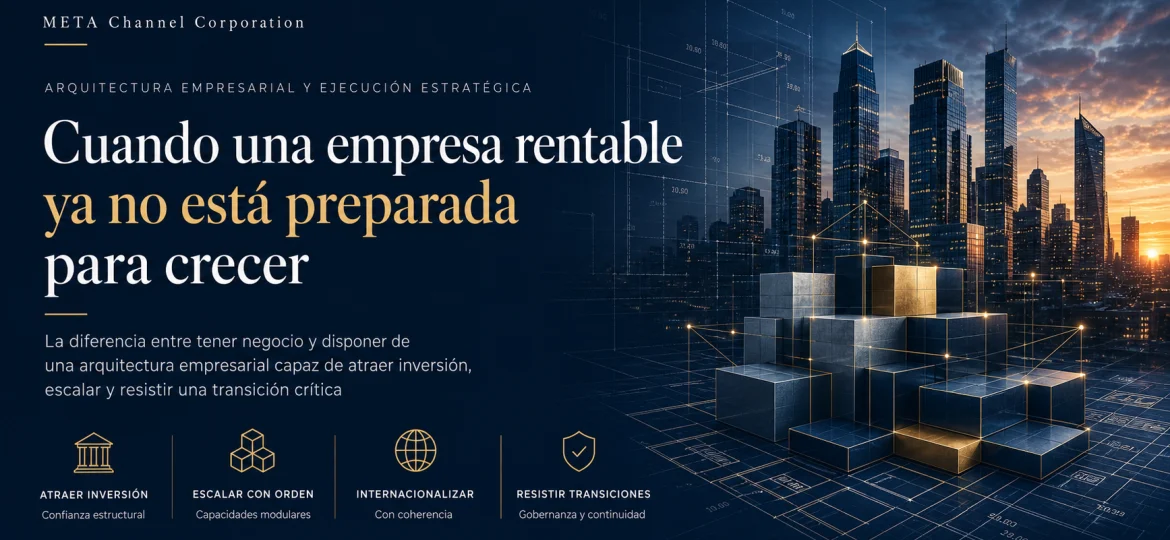
The difference between having a business and having a business architecture capable of attracting investment, supporting expansion and resisting a critical transition
META Channel Corporation | Enterprise Architecture
There are companies that work. They invoice, they have clients, assets, local reputation, accumulated knowledge and a reasonable position in their market. Some have been generating profits for years. Others have grown over decades on a founder’s intuition, family trust, a well-worked network of business relationships and a way of doing things that, for a long time, was enough.
But there comes a time when profitability is no longer the only relevant question.
The question is no longer just if the company sells, if it has margin or if it maintains a stable customer base. The question is whether that company is prepared to grow without breaking down, finance itself without improvising, incorporate partners without losing control, internationalize without generating unnecessary risks, attract investment without showing a weak structure or overcome a generational transition without destroying value.
Many companies are not blocked because of a lack of business. They become blocked because their structure no longer supports the complexity that the business itself has generated.
This problem appears especially clearly in family businesses, although it is not exclusive to them. The family business is usually the most visible example because it concentrates, in the same reality, heritage, power, affections, history, ownership, management and succession. During the first stage, this concentration can even be an advantage. Decisions are quick, the founder knows every corner of the business, trust replaces many procedures, and the company moves forward through a mix of personal authority, commercial intuition, and practical discipline.
The problem appears when that model enters a different phase.
When you have to incorporate the next generation. When children do not have the same vision. When an external partner appears. When a financial entity requires more sophisticated information. When an investor asks about contracts, risks, contingencies, governance and reporting. When you intend to open a market abroad. When the operating company coexists with real estate, family loans, cross-shareholdings, informal decisions, incomplete documentation and insufficient technology. When the business continues to operate, but the structure that supports it belongs to a previous stage.
This is where a common confusion occurs: believing that it is enough to create a holding company, sign a family protocol or carry out a corporate reorganization so that the company is prepared for the future.
But it’s not enough!
The holding company can be a useful tool. It can allow you to organize shares, separate operating and holding companies, channel dividends, structure investments, prepare a succession or protect certain assets. But a holding company, by itself, does not turn a company into an organization prepared for growth. It can be a piece within the architecture, not the entire architecture.
A company can have a holding company and continue functioning with decisions concentrated in a single person. It may have family protocol and lack serious reporting. You can have a tax advisor and not have well-ordered internal contracts. It may have benefits and not be defensible to an investor. You may have assets and not be prepared to take on debt, sell a business unit or open a subsidiary in another country. It can be familiarly organized and yet business-wise not prepared for the next phase.
This distinction is important.
Family business specialists fulfill a necessary function when they work on continuity, succession, property, protocol, relationship between generations, entry rules for family members, property transmission and coexistence between family and business. That work may be essential. But it does not exhaust the problem. In many cases, it mandates family continuity, but does not necessarily transform the company into a bankable, investable, internationalizable and operationally robust structure.
Family protocol can order coexistence. Business architecture must organize the capacity for growth. There is the difference.
The contemporary challenge for many companies is not only to transmit the company to the next generation. It is to turn it into an organization capable of operating in more demanding markets, resisting regulatory pressure, attracting talent, incorporating technology, negotiating with third parties, structuring financing, separating risks, documenting processes, protecting intangible assets and executing complex decisions without depending exclusively on personal relationships or the memory of the founder.
A profitable company is not necessarily an investable company.
To be investable, a company must be able to be understood, audited, valued, defended and projected. It must show a clear corporate structure, intelligible governance, orderly contracts, useful financial information, defined responsibilities, documentary traceability, reasonable regulatory compliance and execution capacity. It is not about turning all companies into unnecessarily sophisticated corporate groups. It is about putting the structure at the level of the real value of the business.
The private market is becoming more demanding. Banks, investors, industrial partners, family offices, strategic buyers and public entities do not only look at the income statement. They look at structure. They look at risks. They look dependent on the founder. They look at labor, fiscal, contractual, technological and regulatory contingencies. They see if the company can function without improvisation. They look to see if the information exists, if it is organized and if it can sustain an operation.
And here many companies with good business show their fragility.
Not because they are bad companies, but because they grew with a different logic. They grew from opportunity, family, territory, personal relationship, job and resistance. That has value. But when a complex operation arrives, that value needs shape. It needs structure. It needs architecture.
Enterprise architecture is not about making pretty organizational charts or accumulating partnerships. It consists of aligning law, technology, government, operation, compliance and investment so that the company can act with greater control. An operating company must know what risks it assumes. A patrimonial company must have a clear function. An international subsidiary should not be opened on impulse. An investment vehicle must respond to a coherent economic, legal and fiscal logic. Technology should not be limited to purchasing software. Regulatory compliance should not only appear when a problem arises. Documentation should not depend on scattered folders, old emails and WhatsApp conversations.
A company that wants to grow needs more than isolated advice.
Needs coordination.
That is one of the great deficits of many medium-sized companies. They have a manager, lawyer, tax professional, labor advisor, technology provider, bank, consultant, auditor or notary. But each one looks at a part. The taxman looks at taxes. The lawyer looks at partnerships or contracts. The technologist looks at tools. The bank looks at debt. The consultant looks at strategy. The problem is that the company does not always have a common architecture that integrates all those pieces into an executable direction.
When that happens, the company accumulates recommendations, but does not necessarily move forward. Partial decisions are made. A society is created without reviewing governance. Technology is hired without redesigning processes. There is talk of investment without preparing documentation. Internationalization is proposed without adequately analyzing contracts, taxation, data, operational structure and regulatory risks. There is talk of succession without reviewing whether the company that is going to be transferred is really prepared to survive the change of command.
The relevant question is not only how much the company invoices.
The question is whether it supports a complex operation.
Can it receive investment without exposing internal weaknesses? Can you incorporate a partner without opening a control conflict? Can you separate family wealth and business risk? Can you sell one business unit without crippling the rest? Can you open a market in another country without improvising a structure? Can you trade with a bank or an investor from an order position? Can it work if the founder stops deciding everything? Can you demonstrate that your contracts, data, processes, technology and compliance are under control?
If the answer is no, the problem is not one of profitability. It’s architecture.
At META Channel Corporation we work precisely at that point: when a company with real business needs to organize its legal, technological, operational and governance structure to grow, finance, internationalize or face a critical transition without destroying value.
It is not about replacing the family, tax, corporate, technological or financial specialist. It is about integrating these pieces under an execution logic. The company does not need more disjointed reports. It needs strategy, law, technology, regulation and operation to move in the same direction.
This vision is especially useful for family businesses in the transformation phase, but is not limited to them. It also affects local groups that have grown without sufficient formal structure, property companies with real economic activity, expanding industrial companies, tourism businesses, private clinics, distribution companies, technological companies, agri-food projects, service operators, companies with real estate assets linked to exploitation and companies that seek to make the leap from a local logic to a national or international structure.
The family business is just one of the scenarios where the problem is seen more clearly.
The true entry point is not that the company is family-owned. The entry point is that there is unresolved structural complexity.
A company may have been very efficient for twenty years and yet be unprepared for the next five. You may have built value, but not ordered it. You may have assets, but not a defensible structure. You may have a market, but not a scalable organization. It may have history, but not an architecture suitable for investment, expansion or transition.
That difference will become increasingly important.
In an environment where regulation increases, financing requires more information, technology redefines processes and markets open to cross-border operations, the company that does not organize its structure is at a disadvantage. It doesn’t necessarily disappear, but it negotiates worse. It grows worse. It is financed worse. He defends himself worse. And, when the time comes for a succession, a sale, an investment or an international expansion, you discover too late that your problem was not the business, but the way the business was built.
Therefore, enterprise architecture is no longer a luxury for large groups. It is an intelligent survival condition for real companies that have reached a point of maturity and cannot continue operating as if complexity does not exist.
Profitability shows that a company has value. Architecture demonstrates that this value can grow, be financed, transmitted, defended and executed.