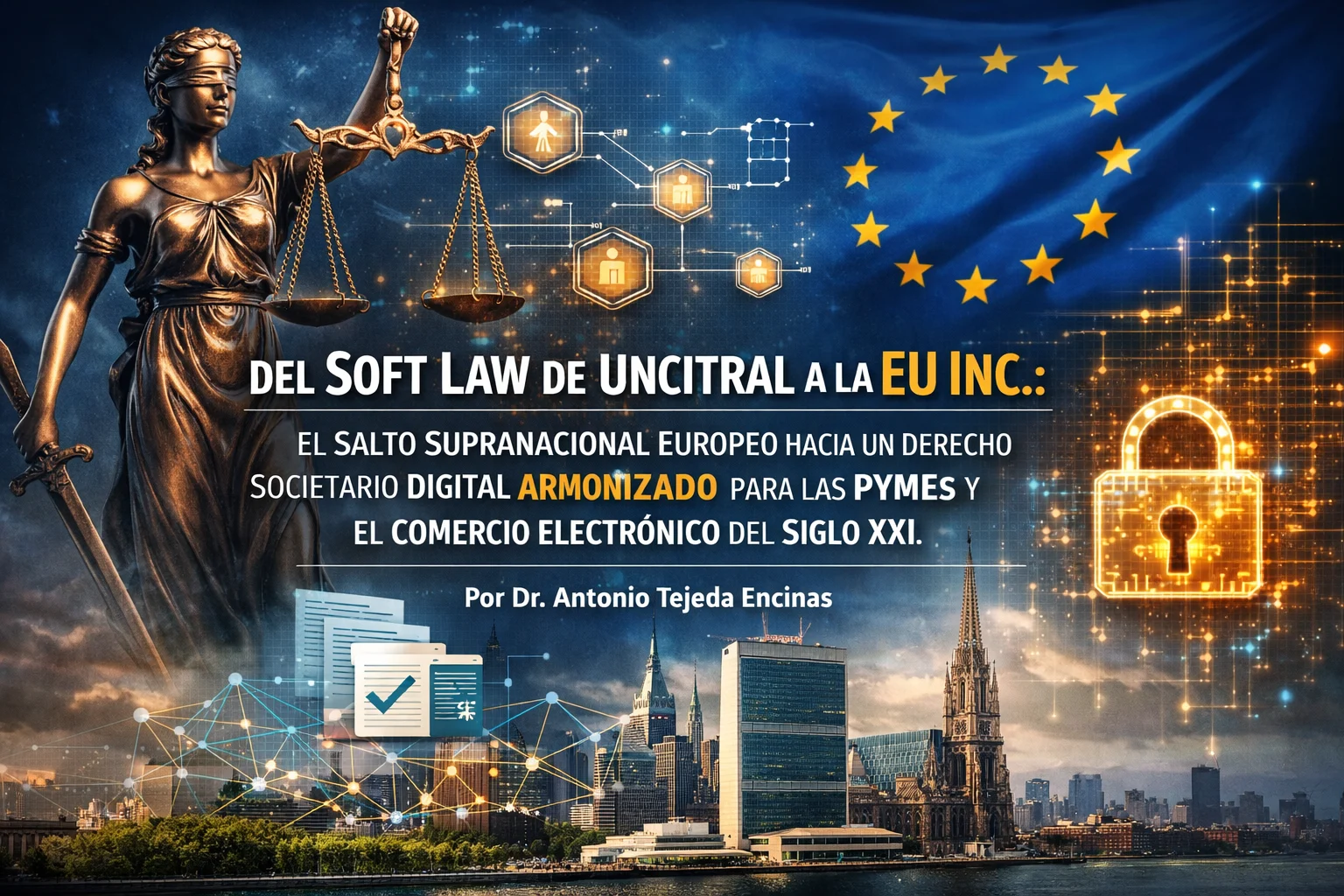
FROM UNCITRAL SOFT LAW TO EU INC.: THE EUROPEAN SUPRANATIONAL LEAP TOWARDS A HARMONIZED DIGITAL CORPORATE LAW FOR SMEs AND E-COMMERCE OF THE 21ST CENTURY
By: Antonio Tejeda Encinas SJD / Dr. iuris in European Union Law | International Observer in Working Groups I (MSMEs/SMEs) and IV (Electronic Commerce) of the United Nations Commission on International Trade Law (UNCITRAL), within the framework of the Inter-American Federation of Bars (FIA/IABA, Washington DC). He has participated in sessions held at the Vienna International Center (Vienna) and at the United Nations headquarters in New York (UN Headquarters).
On March 18, 2026, the European Commission presented the proposal for Regulation COM(2026) 321 final, entitled “Proposal for a Regulation of the European Parliament and of the Council on the 28th Regime Corporate Legal Framework – ‘EU Inc.’”.
This initiative is not another technical adjustment within the European corporate acquis. It represents the creation of a new optional corporate type – the EU Inc. – conceived as a true “28th regime” parallel to the 27 national systems: a fully digital limited liability company, harmonized at a supranational level and designed to operate without legal friction throughout the single market.
Its structural features are ambitious and practical: fully telematic constitution in less than 48 hours and for a cost of less than 100 euros; flexible capital (potentially no mandatory minimum); fully dematerialized shares managed by the company’s own digital registry; and intensive use of the European Digital Identity Wallet (EUDIW) and the Business Registers Interconnection System (BRIS).
The proposal responds directly to the diagnoses of the Letta (2024) and Draghi (2025) reports, which identify corporate fragmentation as one of the main implicit costs of the single market and as a key factor that pushes European startups towards more agile jurisdictions, such as Delaware. When two reports of this caliber coincide in the diagnosis, we are not facing an academic hypothesis, but rather a clear signal of normative direction.
The real novelty is not the mere introduction of a new corporate form, but the structural shift that it entails: for the first time, the European Union is not limited to harmonizing pre-existing national categories, but rather configures an original corporate regime, conceived from its origin as the digital legal infrastructure of the single market.
I. The EU Inc. proposal: a digital supranational regime by default
EU Inc. forms a limited liability company with its own legal personality and automatic recognition in the 27 Member States. Its key elements are:
* 100% digital constitution: harmonized form, qualified electronic signature (eIDAS 2.0) and integration with the EUDIW. The “once-only” principle allows automated data circulation via BRIS.
* Flexible capital: without mandatory minimum in many cases, with creditor protection based on effective solvency and responsibility of administrators.
* Dematerialized shares: digital registry managed by the company itself, technologically neutral and compatible with DLT infrastructures.
* “Born digital” governance: electronic procedures for statutory modifications, assemblies, mergers and simplified liquidation.
* Main legal basis in art. 114 TFEU, which enables its adoption by qualified majority.
Unlike Societas Europaea (oriented towards large groups), EU Inc. is digital-first and is designed especially for startups, scale-ups and SMEs that naturally operate in cross-border environments.
II. UNCITRAL as a conceptual substrate: technological neutrality and functional equivalence
Since 1966, UNCITRAL has been the UN’s main forum for modernizing international trade law. Two principles have guided its work: technological neutrality and functional equivalence between physical and electronic media.
Two relevant instruments stand out:
1. The Model Law on Electronic Transferable Records (MLETR, 2017) -arts. 10 and 11-, which recognizes that an electronic record is equivalent to a paper one when it guarantees uniqueness, integrity and exclusive control.
2. The Legislative Guide on Limited Liability Enterprises (2021), from Working Group I (MSMEs), which recommends simplification, capital flexibility and digital governance to reduce barriers to micro and small businesses.
UNCITRAL generates soft law: global legal coherence, but without binding force or common infrastructure.
III. The European leap: from soft law to supranational hard law with infrastructure
Here lies the European uniqueness: the ability to transform international principles into directly applicable standards, supported by real operational infrastructures (BRIS, EUDIW, eIDAS 2.0).
The EU Inc. is the best example: UNCITRAL provides the transnational legal grammar; The European Union provides uniform enforceability within the single market.
IV. Functionally convergent elements
* Dematerialization of shares: functional equivalence of the MLETR.
* Capital flexibility: recommendations from the 2021 Legislative Guide for MSMEs.
* Identity and digital procedures: European implementation of technological neutrality.
The difference is not in the principles, but in the institutional capacity to make them operational on a continental scale.
V. International comparison and national fit
EU Inc. aspires to fulfill a role in Europe similar to that of Delaware in the United States, but with the advantage of automatic recognition in 27 jurisdictions. Experiences such as those of Estonia or Singapore are advanced, although limited to their national scope; the EU raises them to the level of a single market.
There remain regulatory challenges (mortis causa transmissions, property rights, AML controls). The principle of primacy of EU law will be key. According to the Impact Assessment, administrative savings could reach 2,000 million euros annually.
VI. Implications for SMEs and cross-border e-commerce
EU Inc. drastically reduces the costs of incorporation and cross-border scalability. It facilitates pan-European investment, crowdfunding, stake tokenization and digital schemes compatible with RGPD and the European regulatory ecosystem.
Therefore:
The EU Inc. closes a cycle of decades: the principles of technological neutrality and functional equivalence developed in UNCITRAL find in Brussels the institutional capacity to become a uniform and directly operational regime.
From the soft law of Vienna and New York to the digital hard law of the single market. When international commercial law meets supranational regulatory power and common infrastructure, it stops being a theoretical exercise and becomes a real competitiveness tool for European SMEs of the 21st century.
Main sources:
* COM(2026) 321 final, March 18, 2026.
* Impact Assessment SWD(2026) 322 final.
* UNCITRAL MLETR (2017) and Legislative Guide on Limited Liability Enterprises (2021).
*Letta (2024) and Draghi (2025) reports.