
Antonio Tejeda Encinas, President of CEA Digital Law (Euro-American Committee of Digital Law)
Smart contracts offer considerable technological scope for on-chain automation, making it possible to automate processes and to interact both on-chain and off-chain. This is done by executing commands coded into the contract.
However, it is important to stress that the ability to code instructions, carry out clearing and settle transactions — payment versus payment and delivery versus payment — does not necessarily produce automatic legal effects.
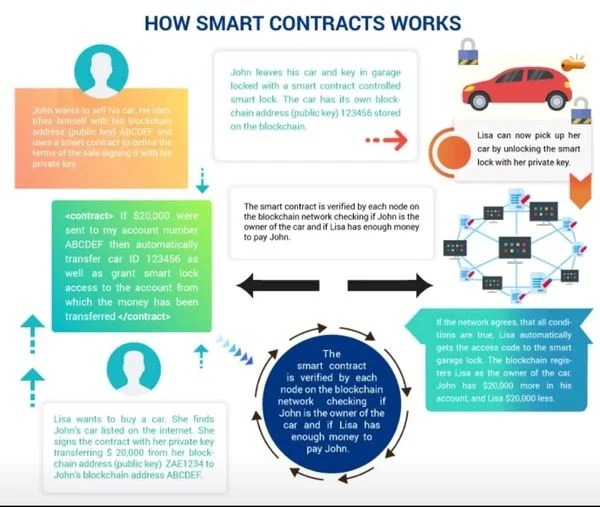
The accompanying illustration exemplifies this point. The transaction described there would allow a real-world asset (RWA) to be traded on-chain, giving access to the (previously deposited) asset through tokenisation and smart contracts (delivery versus payment). This would happen once the buyer has paid the price set by the seller using tokenised money.
However, it is crucial to understand that acquiring a real-world asset requires more than simply coding the transfer of access to it. The legal requirements must be met. This means that there must be an effective transfer of ownership or of rights of use (which requires consent, object and cause). In addition, the proper procedures must be followed, whether for the acquisition itself or to establish the acquirer’s entitlement. It is also essential that the token holder is the rightful owner or has the necessary authority over it. Otherwise, the legal recognition of good-faith acquisitions based on apparent title, among other matters, must be considered.
In short, holding a TOKEN acquired through a smart contract does not automatically confer the status of owner or rightful holder of the value or right notionally backed by the TOKEN. The legal effects of smart contracts will be determined by the applicable rules, both between the parties and more broadly.
Image source: Hashcash Consultants (2023)