Tenerife as a Technological Innovation Hub: Opportunities, Challenges and Keys to Success from the Comité Euro Americano de Derecho Digital and META Channel Corporation
By Antonio Tejeda Encinas, President of the Euro-American Digital Law Committee -CEA Digital Law and CEO of META Channel Corporation
The recent news that places Tenerife as a potential destination for investment by technology giants such as Huawei and Samsung marks a turning point in the economic history of the island. However, for these initiatives to transcend the phase of preliminary meetings and become tangible realities, it is essential to carry out an in-depth analysis that encompasses both the competitive advantages and the structural limitations that Tenerife faces. As President of the Euro-American Digital Law Committee -CEA Digital Law and CEO of META Channel Corporation, my experience in both academic research and business practice allows me to offer a comprehensive and strategic vision on this topic.
Tenerife’s geographical location offers an undeniable advantage: its position as a natural link between Europe, Africa and America. This geopolitical situation allows the island to aspire to become a strategic node of technological innovation and business development. For Huawei and Samsung, seeking to strengthen their global presence, Tenerife could represent a unique entry point to emerging markets in Africa and an ideal location to coordinate transatlantic operations.
However, this advantage may be overshadowed if certain challenges inherent to insularity, such as limited air connectivity and high logistics costs associated with the transportation of goods and technological equipment, are not effectively addressed. For example, the limited frequency of direct flights from Tenerife to global technology centers such as Silicon Valley, Seoul or Shenzhen could become a real obstacle to the mobility of executives, technicians and materials. This problem not only impacts investment potential, but also the perception of international companies about the operational viability of the island.
From the Comité Euro Americano de Derecho Digital — CEA Digital Law, we have insisted that sustainable technological development requires an advanced infrastructure that guarantees competitiveness in the global market. While Tenerife has taken important steps in terms of digitalization, the demands of giants like Huawei and Samsung go far beyond the basics. These companies require state-of-the-art telecommunications networks, data centers with international certifications and cybersecurity systems that comply with the strict regulations of the European Union, such as the General Data Protection Regulation (GDPR).
A concrete example that illustrates this need is the increasing demand for local data processing due to restrictions on cross-border transfers imposed by the GDPR. For a company like Huawei, which develops artificial intelligence and mass storage technologies, the lack of local data centers in Tenerife could be a reason to reconsider its interest in the island.
In addition, underwater connectivity, key to ensuring fast and secure global communications, must be expanded. Tenerife, with its position in the Atlantic, has the potential to become a key connecting node between continents, but this requires significant investments in state-of-the-art submarine cables that guarantee both speed and redundancy.
Local Talent: A pending issue
Human talent is the most valuable resource in the technological field, and this is where Tenerife faces a critical challenge. Although the island has universities and training centers that produce professionals in areas such as computing and engineering, the current offering is not aligned with the specific needs of high-tech companies. This mismatch between educational supply and business demand could stop the arrival of strategic investments.
At META Channel Corporation, we have worked in other markets designing training programs in collaboration with universities and companies. A viable solution for Tenerife would be to implement dual training models, where students combine their academic education with paid internships in technology companies. In addition, the island must position itself as an attractive destination for international talent. This requires addressing key issues such as housing quality, educational provision for expatriate families and cultural integration.
For example, cities like Dublin (our headquarters) and Tallinn have managed to attract thousands of international tech workers thanks to a combination of work incentives and robust social infrastructure. Tenerife could aspire to a similar model, adapted to its island particularities.
Housing and massification: A structural obstacle
One of the least mentioned but extremely important aspects is the housing crisis that affects Tenerife. Tourist overcrowding and the limited supply of accessible housing could become a deterrent for those who do not telework and need to perform local functions. Technology companies need to ensure that their employees have access to adequate and affordable housing. Otherwise, the island’s appeal as an investment destination could quickly fade.
For example, in markets like San Francisco, the lack of affordable housing has led many technology companies to look for alternatives in other cities. If Tenerife does not take proactive measures, it risks repeating this mistake. One solution could be the creation of incentives for sustainable real estate developments aimed at professionals in the technology sector, combined with policies that stop real estate speculation.
Tax incentives: An attractive but improvable framework
The Economic and Fiscal Regime (REF) of the Canary Islands is, without a doubt, an important attraction for foreign companies. However, in a global environment where many jurisdictions offer advantageous tax conditions, Tenerife needs to go further. In addition to tax exemptions, it would be useful to implement specific subsidy programs for research and development (R&D) projects, as well as facilitate access to financing for local startups that can integrate into the value chain of companies such as Huawei and Samsung.
A practical example of success in this area is the Irish model, which combines a low corporate tax with strong state support for innovation. Tenerife could learn from this approach, adapting it to European regulations and the specific needs of the island.
Sustainability: Green technology for a responsible future
Sustainability must be a central axis of any technological development strategy in Tenerife. As we have pointed out from the Comité Euro Americano de Derecho Digital — CEA Digital Law, the balance between economic development and environmental protection is not optional, but essential. This is especially true in an island environment like Tenerife, where resources are limited and the pressure on the environment is significant.
Technological investments must be aligned with sustainable practices, such as the use of renewable energy to power technological infrastructures and the implementation of circular economy models that reduce waste. For example, Huawei and Samsung could lead green technology projects on the island, demonstrating that technological development and sustainability can go hand in hand.
Limited international connectivity. Beyond technological connectivity, Tenerife faces insufficient physical connectivity. Without regular direct flights to technology hubs such as San Francisco, Berlin or Singapore, attracting talent and maintaining business relationships becomes more complicated. This problem is already facing other islands in the Mediterranean, where the lack of connectivity has reduced the interest of global technology companies.
Lack of a consolidated technological ecosystem. Currently, Tenerife lacks an ecosystem that encourages collaboration between startups, universities and large corporations. In places like Barcelona, the creation of technological hubs has been key to attracting investments and generating innovation. Tenerife needs to focus on the creation of physical and virtual spaces where these interactions can flourish.
Insufficient international promotion. Although the meetings with Huawei and Samsung are a good start, Tenerife needs to develop a broader global marketing strategy. This involves participating in international events, establishing representative offices in key markets and creating campaigns that position the island as an innovative and sustainable technological destination. A successful example of this strategy is Lisbon, which has managed to position itself as an emerging technology hub thanks to its active participation in international fairs and conferences, in addition to offering an attractive tax framework and a high quality of life.
Preparation for the arrival of large multinationals. It is not enough to attract companies of the caliber of Huawei or Samsung; It is crucial to ensure that its installation does not generate social or economic imbalances. This includes everything from managing the impact on the local labor market to developing urban policies that prevent gentrification and social exclusion. For example, Seattle’s case with Amazon shows how the arrival of large corporations, if not managed properly, can lead to problems such as cost of living inflation and the displacement of local residents.
The arrival of Huawei and Samsung to Tenerife could be the catalyst that transforms the island into a global benchmark in technological innovation. However, for this vision to materialize, it is essential to proactively address the challenges we have identified and take advantage of the unique opportunities that Tenerife can offer.
From the Comité Euro Americano de Derecho Digital — CEA Digital Law, we will continue working to guarantee that technological investments that come to Tenerife are aligned with the highest standards of sustainability, competitiveness and regulatory compliance. On the other hand, from META Channel Corporation, we will continue to promote collaboration between international and local companies, helping to build a technological ecosystem that benefits both Tenerife and the rest of Europe.
This is a historic moment for Tenerife, but success will not come automatically. It requires strategic vision, effective leadership and an unwavering commitment to sustainable development and the well-being of the local community. If we manage to articulate these pieces, Tenerife will not only be a technological investment destination, but also an example for other regions of the world that seek to balance economic development, innovation and sustainability.
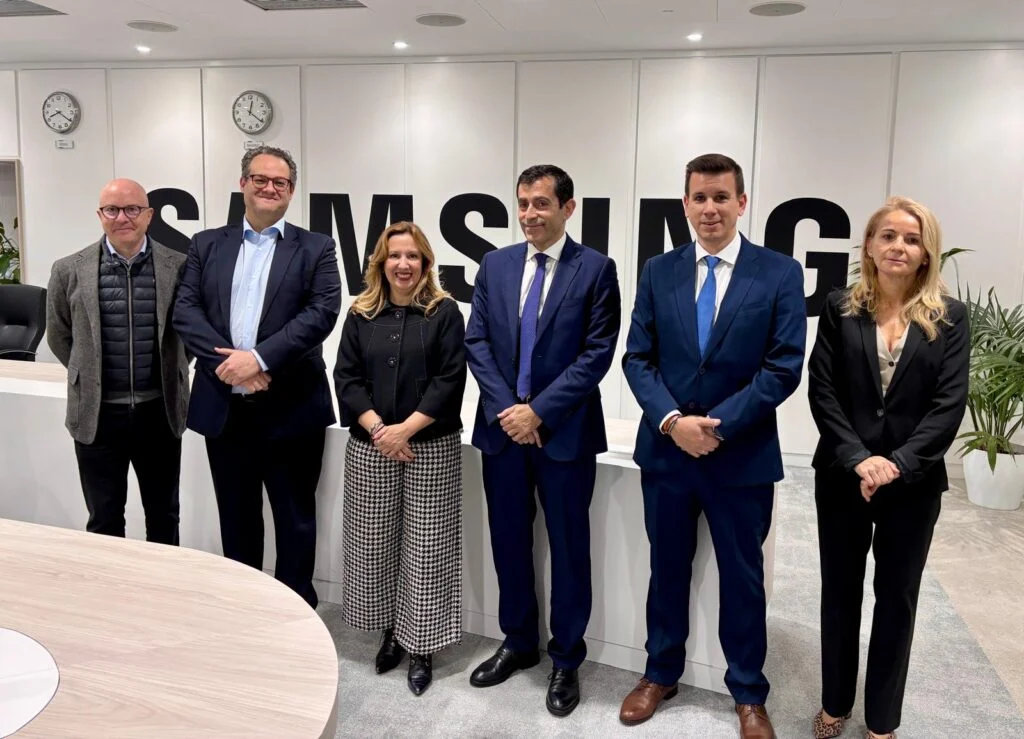
Photo:
Meeting with the management leadership of Samsung Spain. Credit: Cabildo de Tenerife.