
Antonio Tejeda Encinas, International Observer, United Nations Commission on International Trade Law (UNCITRAL), Working Group I (Micro, Small and Medium-sized Enterprises); lawyer; CEA Digital Law (Euro-American Committee of Digital Law)
This UN–ILO report sets out to examine the importance of social dialogue in the age of artificial intelligence (AI). The integration of this technology into the world of work poses unprecedented challenges that can only be met through a collaborative approach among the social partners. Below are the key points of the report entitled Mind the AI Divide: Shaping a Global Perspective on the Future of Work, published on 26 July 2024.
The report, co-authored by the International Labour Organization (ILO) and the Office of the UN Secretary-General’s Envoy on Technology, addresses the profound disparities in AI adoption worldwide and how these technological inequalities are affecting economies, particularly in low- and middle-income countries.
Social dialogue and AI: global challenges
The report highlights vital issues such as the digital divide, global inequalities, reskilling, the international governance of AI, the impact on gender inequality and vulnerable groups, and the need to foster public–private cooperation to ensure that work remains sustainable in the future.
In this context, social dialogue is not an isolated issue. It is intrinsically linked to all these questions, in particular to workers’ lifelong learning and to cooperation between the public and private sectors. The report argues that social dialogue may be the most effective tool for ensuring that AI not only improves business competitiveness but also respects and strengthens workers’ rights.
A few brief reflections that strike me as both global and local:
The international and national dimensions of social dialogue
AI is a global phenomenon, but its implementation and the frameworks for social dialogue vary considerably from country to country. While in Spain tripartite negotiating tables bringing together employers, trade unions and government are well established, in other countries a lack of infrastructure and union organisation weakens the process. In this context, organisations such as the ILO play an essential role in promoting global standards and sharing best practice.
Regionalism and globalisation in the post-COVID era
COVID-19 accelerated the shift towards a more regional form of globalisation. Employers’ organisations and trade unions now focus on strengthening local supply chains and avoiding excessive dependence on external markets. In the Canary Islands, for example, trade unions have taken a more territorial stance, defending workers’ rights in key sectors such as tourism and public services. At the same time, Spanish business associations have sought to maintain internal flexibility through mechanisms such as ERTEs (temporary lay-off schemes).
Other circumstances that have affected social dialogue
In addition to COVID-19, other events such as the 2008 financial crisis have had a significant influence on social dialogue by highlighting the need to balance flexibility and job security. The austerity policies that followed eroded trust in these mechanisms, especially in Spain, where the 2012 labour reform remains divisive despite subsequent reforms (Royal Decree-Law 32/2021, Royal Decree-Law 8/2023 and Royal Decree-Law 2/2024).
The Canary Islands: a tailored model of social dialogue
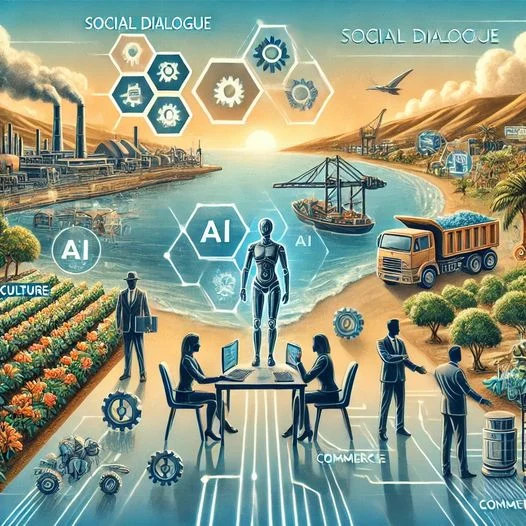
The Canary Islands, with an island economy based on vulnerable sectors such as tourism, agriculture, trade and logistics, require social dialogue to be specifically adapted to the technological disruption posed by AI. Transforming these sectors calls for a coordinated approach between government (the Office of the President of the Government of the Canary Islands and the Cabildo de Tenerife), employers (CEOE-Tenerife) and trade unions (UGT Tenerife and CCOO Tenerife) to safeguard jobs and regional competitiveness.
We propose the creation of the “CanariasTech Hub”, a regional platform to assess the impact of AI on key sectors such as tourism, agriculture, trade and logistics. The platform will also promote policies tailored to the region’s specific needs, ensuring that technology is implemented in a way that protects both jobs and competitiveness.
In addition, the “Tech Talent Canarias” initiative will bring companies and government together in lifelong learning programmes designed to equip workers with the skills they need to face the digital transformation, ensuring that vulnerable sectors such as tourism and agriculture can remain relevant in an increasingly automated environment.