
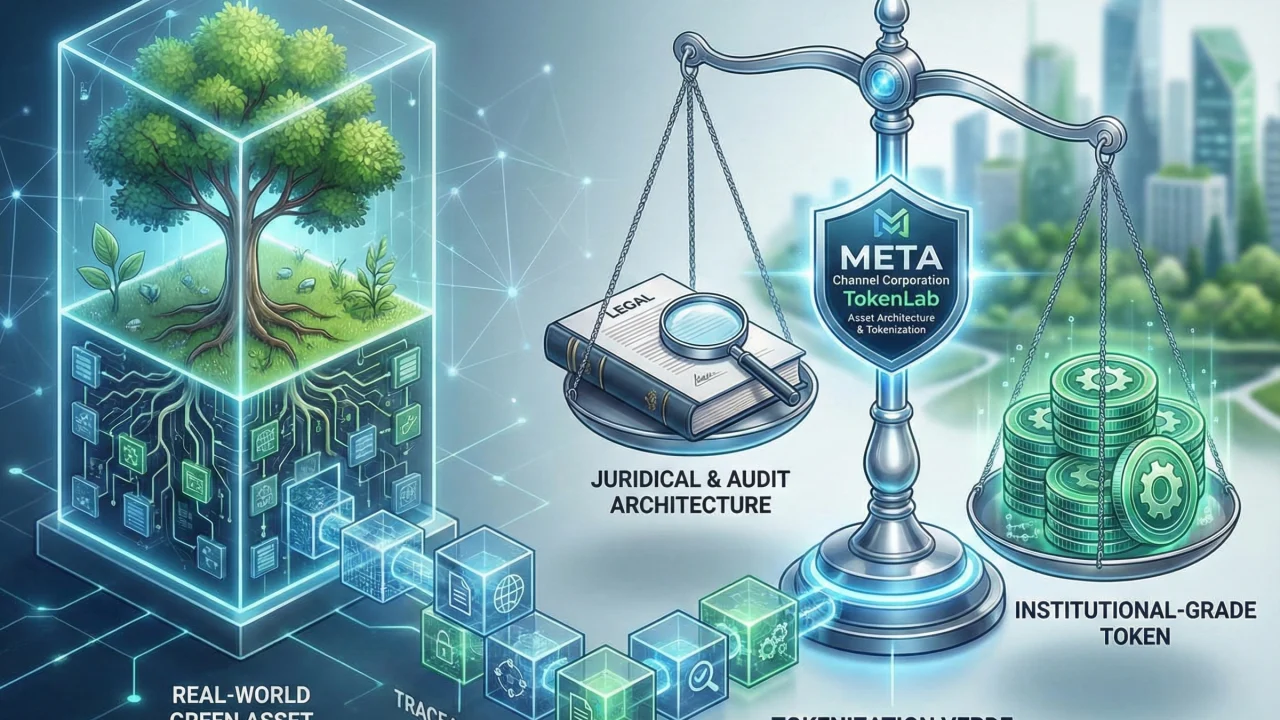
META Channel Corporation | TokenLab™ – Asset Architecture & Tokenization
For years, the debate on tokenization has been contaminated by two opposing caricatures: either it is presented as a technological panacea capable of “fixing” entire markets through the simple effect of digitization, or it is dismissed as a sophisticated form of speculation with a crypto veneer. Both readings are incomplete and, in the area of environmental assets, dangerously reductive.
Tokenization is not a slogan. It is a technique of representation and transfer of rights, and, if designed well, a mechanism to raise institutional standards: traceability, auditability, governance, responsibility, compatibility with reporting and, above all, defensibility in real conflict. The decisive nuance is there: in real conflict. Not in a pitch, not in a whitepaper, not in a demo. What happens when the regulator asks, when an auditor puts pressure, when an institutional buyer demands guarantees, or when a third party challenges the validity of the environmental attribute that is being marketed.
In “green tokenization” this nuance is even more demanding because the aim is to convert a fact of the physical world (a reduction, a capture, an avoidance of emissions; a renewable attribute; a measurable impact on an ecosystem) into an asset that can be financed, circulate and be recognized as a unit of value. That’s ambitious. And precisely for this reason it cannot be built from technological ingenuity.
What is tokenization, seriously (and what it is not)
Tokenizing is not “putting something on the blockchain.” Tokenizing is defining an economic-legal object, providing it with a regime of issuance, verification, transfer, limitations, extinction and challenge, and then representing it through a digital instrument that allows its circulation with enforceable rules. The token does not create the asset; the token represents the asset. That difference separates institutional design from technological theater.
In practice, a token can represent many things: a credit right, a participation, a right of use, a certification, a “claim” over a result, or an accounting unit that operates as evidence. In green assets, this ambiguity is exactly the focus of risk: there is talk of “tokenized tons” as if the token, by its mere existence, were equivalent to a “real” and “reliable” reduction or capture.
It is not.
Blockchain can ensure record integrity, temporal sequencing, and resistance to history tampering. But it cannot alone guarantee the veracity of what enters the system. Environmental data enters through some channel: an auditor, a standard, a measurement methodology, a sensor, a verified report, an official record or an accredited third party. There is the reality, and there are the responsibilities.
When this is ignored, a new version of the old problem is born: greenwashing. Only it is no longer a clumsy greenwashing, but one that dresses up technical infrastructure that is not legally protected.
Greenwashing is not going away: it is becoming more sophisticated
The usual promise is seductive: “every ton captured will be a unique, traceable token, without double counting, and the value goes directly to the regenerative project.” It’s a good story. But it confuses three different planes.
First, “on-chain” uniqueness does not avoid “off-chain” double counting if there is no exclusivity regime for the environmental attribute and serious control of retirements, cancellations, substitutions, subrogations or revalidations. You can have a unique token and, simultaneously, a parallel claim in another registry, or a duplication due to a change in methodology, or a subsequent invalidation of the credit due to audit. The blockchain does not correct that: the legal and governance architecture does.
Second, “without intermediaries” is a myth when we talk about environmental assets with institutional pretensions. There is always relevant intermediation: verification, standards, auditing, data custody, certification, supervision, reporting, and in many cases, regulated intermediation. What tokenization can do is reduce friction and automate processes, but it cannot eliminate the trust loop. In green assets, trust is not a whim: it is the basis of legitimacy of the asset.
Third, “liquid” does not mean “saleable.” Liquidity is not created by technology, it is created by the market; and the institutional market does not buy tokens, it buys defensible rights. If the asset does not have a clear validity, liability and dispute resolution regime, the serious market perceives it as risk, not liquidity.
Here is the key idea: tokenization can be an excellent tool for building integrity, but it can also become a machine for packaging uncertainty. What makes it one thing or another is not the chain, it is the design.
Green tokenization: the challenge is not technical, it is institutional
In a green asset four layers come together that must be aligned.
The first layer is the physical fact or environmental impact: what has been done, where, for how long, and with what causal relationship with respect to the emission or capture. The second layer is technical verification: who measures, with what methodology, under what standard, with what periodicity, with what margin of error, with what anti-fraud controls, and what happens if the measurement is revised downwards or invalidated. The third layer is the legal attribution of the environmental attribute: who has the right to claim it, if it is transferable, if it is exclusive, if it is temporary, if it is revocable, how double claims are avoided, and what cancellation or “retirement” mechanisms operate. The fourth layer is the digital instrument: the token, with its issuance, transfer, blocking, and traceability logic.
When you tokenize from the fourth layer backwards, all you get is a technically “nice” asset, but institutionally fragile. And this fragility is exactly what causes rejection by sophisticated buyers, compliance problems and, in the worst case, litigation or sanctions for misleading marketing or defects in the attribution of the right.
Green tokenization done right is designed from the legal and liability layer, not from the smart contract. That’s why there is a lot of noise and little real infrastructure: most players come from technology or ESG marketing, not defensible asset design.
What the institutional market demands (although it does not say it in public)
The serious market is not looking for “green tokens”. It is looking for financing and circulation mechanisms for climate value with guarantees. You want to know what you buy, what you can claim, who is liable, under what jurisdiction, with what audit, with what disability regime and with what remedies if the environmental attribute is not sustained.
This requires, at a minimum, a set of elements that are rarely well resolved: precise legal definitions of the tokenized object; issuance rules linked to verification; evidence custody and evidentiary traceability regime; oracle and data provider governance; conflict of interest policy in verifiers; suspension or “freeze” mechanisms in case of suspicion; cancellation/retirement regime when the attribute is used for claims; and an accountability framework that avoids the classic “DAO is not accountable” loophole.
In other words: the institutional market demands that green tokenization be not a technological toy, but infrastructure.
TokenLab™: tokenizing is not “tokenizing”; is to build investable assets
At TokenLab™, within META Channel Corporation, we treat tokenization as what it is: a results-oriented discipline of legal-technical architecture. The question is not “can we tokenize this?” The question is “can we turn this into a defensible, auditable and financially usable asset without creating a reputational, regulatory or litigation liability?”
When it comes to green assets, the standard must be even higher. Not because the environment is “morally sensitive,” but because the incentives to exaggerate, duplicate or package impact are real, and because regulatory and market scrutiny is growing. The solution is not to refuse to tokenize; The solution is to do it the way you do a serious asset: with rules, evidence, responsibility and correction mechanisms.
Therefore, our approach is based on three principles that we do not negotiate: evidentiary traceability, clear legal attribution and enforceable responsibility. Without those three pillars, the rest is cosmetic.
Evidentiary traceability means that the system not only stores transactions, but evidence: what environmental event is certified, who certifies it, what methodology is applied, what documents support the event, how the chain of custody of that evidence is preserved and how it is audited. In green assets, the “proof” is not an accessory: it is the asset.
Clear legal attribution means that the token does not float around like a vague promise. It must be anchored to a right or a defined legal position. Is it a right to use the environmental attribute for a claim? Is it a transfer right with a retirement obligation? Is it a unit of value tied to an outcome with conditions? If it is not defined, the token can circulate, yes, but what circulates is ambiguity.
Enforceable responsibility means that the system has identifiable responsible parties at each link: verifier, issuer, registry operator, evidence custodian, data provider, frontend operator if there is public capture, and a remediation framework if something goes wrong. A design that “has no responsibility” is a design that, when faced with the first conflict, collapses or becomes toxic.
This gap, the recurring “the DAO is not responding”, is not an inevitable consequence of decentralization, but an architectural failure. In the European context, institutionally sound practice involves anchoring the tokenized asset to an entity with its own legal personality, typically a special purpose vehicle (SPV) or other equivalent structure, which assumes the issuance, custody of evidence, truthfulness obligations and responsibility towards third parties. Serious tokenization does not eliminate law or replace it with algorithmic governance: it integrates it from the origin. The token is not the responsible subject; It is the instrument that represents rights within a structure where there is real capacity for auditing, supervision, claims and conflict resolution when the environmental attribute is invalidated, challenged or reviewed.
Why “programmable” does not mean “automatically correct”
It is often repeated that the tokenized green asset is “programmable” and can be integrated into DeFi to incentivize sustainable behaviors. It’s true, in the abstract. But programming is not equivalent to legitimizing. DeFi does not turn a weak asset into a strong one; makes it faster, more distributed and potentially riskier.
If a green token enters collateral, lending or yield circuits and then the environmental attribute is invalidated, due to a methodology error, due to double counting detected, due to fraud, due to a revision of the standard, the problem is not only reputational: it becomes market risk, counterparty risk and legal risk. Programmability amplifies consequences. Therefore, the previous design must be of a high standard.
Here is a lesson that the market has already learned in other areas: you do not put an asset in financial infrastructures without understanding its validity regime and its liability regime. What is learned with losses in a market, in green assets can be learned with sanctions, litigation and destruction of credibility.
The European framework and the need for regulatory alignment
Europe has clearly moved in the right direction: demanding consistency, traceability, disclosure and responsibility in green claims and sustainability reporting. The regulatory environment is not designed to “kill” innovation; It is designed to reduce information asymmetry and prevent sustainability from becoming a market of promises with a technical appearance. In practice, this leads to a simple conclusion: green tokenization that wants to operate with serious customers must be able to integrate with compliance, auditing, accounting and reporting, not live in a parallel universe.
That’s the point where many projects fail by design: they build tokens, but they don’t build institutional compatibility. And when the sophisticated buyer arrives, a regulated company, financial entity, corporation with demanding reporting, they find that the token “does not fit” into their processes, or worse: it creates risk.
TokenLab™ works precisely to prevent that from happening. It is not about doing something “nice” in a chain; it’s about the asset surviving the real world.
The thesis: the token is not the asset; the asset is the architecture
Green tokenization makes sense when understood as infrastructure to channel capital into verifiable projects and to allow the environmental attribute to be transferred with integrity and rules. But that sense is lost when it is used as a narrative shortcut: “blockchain = trust” and “token = impact.”
The phrase that summarizes the correct framework is this: tokenization does not automatically turn an environmental fact into a reliable environmental asset; it just turns that fact into a transactionable object. From there, the difference between providing value or producing sophisticated greenwashing is whether the token incorporates a serious regime of verification, legal attribution and responsibility.
That’s what separates an initiative that can scale from an initiative that will, at best, be noise; and at worst, it will be a liability.
What “doing it right” means in practice
Getting it right means designing the asset first and then the token. It involves defining the object with legal precision, anchoring it to verifiable evidence, establishing issuance and extinction rules, establishing correction and dispute mechanisms, and ensuring compatibility with audit and compliance. It involves real data governance and oracles. It involves deciding what can be automated and what should remain accredited human control. And, above all, it implies assuming that if the asset is intended to be institutional, it must be prepared for the adverse scenario: inspection, challenge, review of standards, fraud, error and conflict between parties.
That is the standard that TokenLab™ applies. Not because it is more “conservative”, but because it is the only standard that allows green tokenization to be more than a fad.
Closing: the value is not in promising, it is in sustaining
The climate economy needs instruments that allow scaling financing and efficient allocation of resources. Tokenization can be part of that infrastructure. But credibility is not printed on a token: it is built into the design.
At a time when the market already distinguishes between ESG marketing and real sustainability architecture, green tokenization will only have a future in the hands of those who treat it as an institutional discipline, not as a product. That is TokenLab™’s positioning: we do not sell narrative, we build defensible assets.
And in green tokenization, that difference is not aesthetic. It’s the difference between contributing to the transition or contributing to the next scandal.