
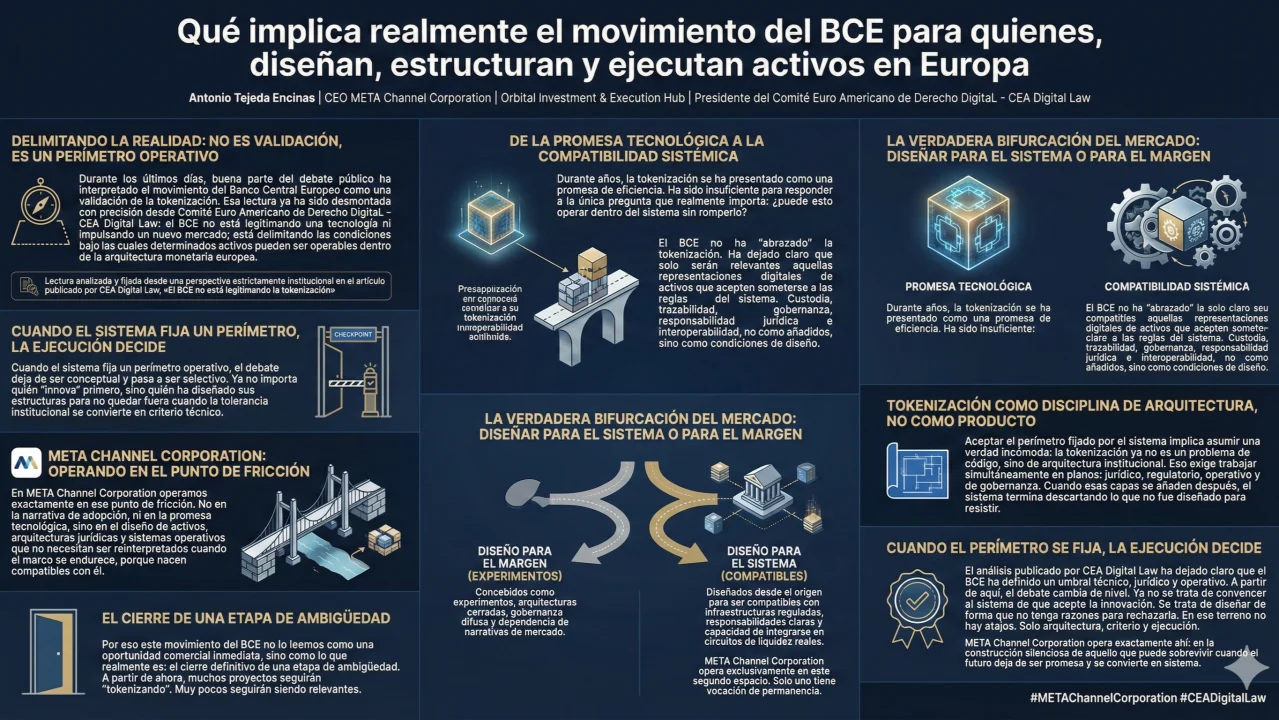
What the ECB’s move really means for those who design, structure and execute assets in Europe
Antonio Tejeda Encinas | CEO META Channel Corporation | Orbital Investment & Execution Hub | President of the Comité Euro Americano de Derecho Digital — CEA Digital Law
Over the past few days, much of the public debate has interpreted the European Central Bank’s move as a validation of tokenization. That reading has already been dismantled with precision since Comité Euro Americano de Derecho Digital — CEA Digital Law: the ECB is not legitimizing a technology or promoting a new market; It is delimiting the conditions under which certain assets can be operable within the European monetary architecture.
This reading has already been analyzed and established from a strictly institutional perspective in the article published by CEA Digital Law, “The ECB is not legitimizing tokenization” (link), where the real scope of the ECB’s movement is precisely delimited. From an execution perspective, that completely changes the conversation.
When the system establishes an operational perimeter, the debate stops being conceptual and becomes selective. It no longer matters who “innovates” first, but who has designed their structures so as not to be left out when institutional tolerance becomes a technical criterion.
In META Channel Corporation we operate exactly at that point of friction. Not in the adoption narrative, nor in the technological promise, but in the design of assets, legal architectures and operating systems that they do not need to be reinterpreted when the framework tightens, because they are born compatible with it.
That is why we do not read this move by the ECB as an immediate commercial opportunity, but as what it really is: the definitive closure of a stage of ambiguity. From now on, many projects will continue to “tokenize.” Very few will remain relevant.
For years, tokenization has been presented as a promise. A promise of efficiency, of disintermediation, of expanded access to assets traditionally reserved for closed circuits. This speech has been useful to open conversation, attract risk capital and justify technological pilots. It has, however, been insufficient to answer the only question that really matters when talking about scale and continuity: Can this operate within the system without breaking it?
The recent positioning of the ECB, doctrinally analyzed by CEA Digital Law, does not introduce a new asset class or legitimize alternative finance models. Set a clear operating perimeter. A perimeter that definitively separates what can be integrated into the European monetary architecture from what will remain, by definition, outside of it. For those operating at the execution level, that perimeter changes everything.
From technological enthusiasm to systemic compatibility
The recurring mistake in the debate on tokenization has been treating it as an end in itself. There has been talk of blockchain, smart contracts and automation as if technical sophistication were the decisive criterion. It is not. It never has been.
Financial systems do not scale by isolated innovation, but by structural compatibility. An asset does not become relevant because it is new, but because it can be guarded, valued, executed, transferred and, if necessary, absorbed by existing liquidity and risk mechanisms.
The ECB has not “embraced” tokenization. He has done something much more demanding: has made it clear that only those digital representations of assets that agree to submit to the rules of the system will be relevant.. Custody, traceability, governance, legal responsibility and interoperability with central infrastructures, not as later additions, but as design conditions.
This change shifts the center of gravity of the debate. The question is no longer whether an asset can be tokenized, but whether it deserves to be designed to survive when the system stops tolerating exceptions. Design for the system or design for the margin This is where the true bifurcation of the market occurs.
From now on, two large families of tokenized assets will coexist. Not because of technology, but because design intent:
- Those conceived as experiments, with closed architectures, diffuse governance and dependence on market narratives;
- and those designed from the beginning to be compatible with regulated infrastructures, with clear responsibilities and the ability to integrate into real liquidity circuits.
Both can exist. Only one has a vocation to permanence.
META Channel Corporation operates exclusively in this second space. Not because it is more comfortable, but because it is the only one where execution makes sense in the medium and long term.
Tokenization as an architectural discipline, not as a product
Accepting the perimeter set by the system implies assuming an uncomfortable truth: tokenization is no longer a problem of code, but of institutional architecture.
This requires working simultaneously on levels that many projects continue to treat as secondary: legal, regulatory, operational and governance. When those layers are added later, the system ends up discarding what it was not designed to resist.
When the perimeter is set, the execution decides
The analysis published by CEA Digital Law has made it clear that the ECB has not legitimized an industry, but rather you have defined a threshold. That threshold is not ideological. It is technical, legal and operational.
From here, the debate changes level. It is no longer about convincing the system to accept innovation. It is about design in a way that has no reason to reject it. There are no shortcuts in this area. Just architecture, criteria and execution.
META Channel Corporation operates exactly there: not in the story of the future, but in the silent construction of what can survive when the future stops being a promise and becomes a system.