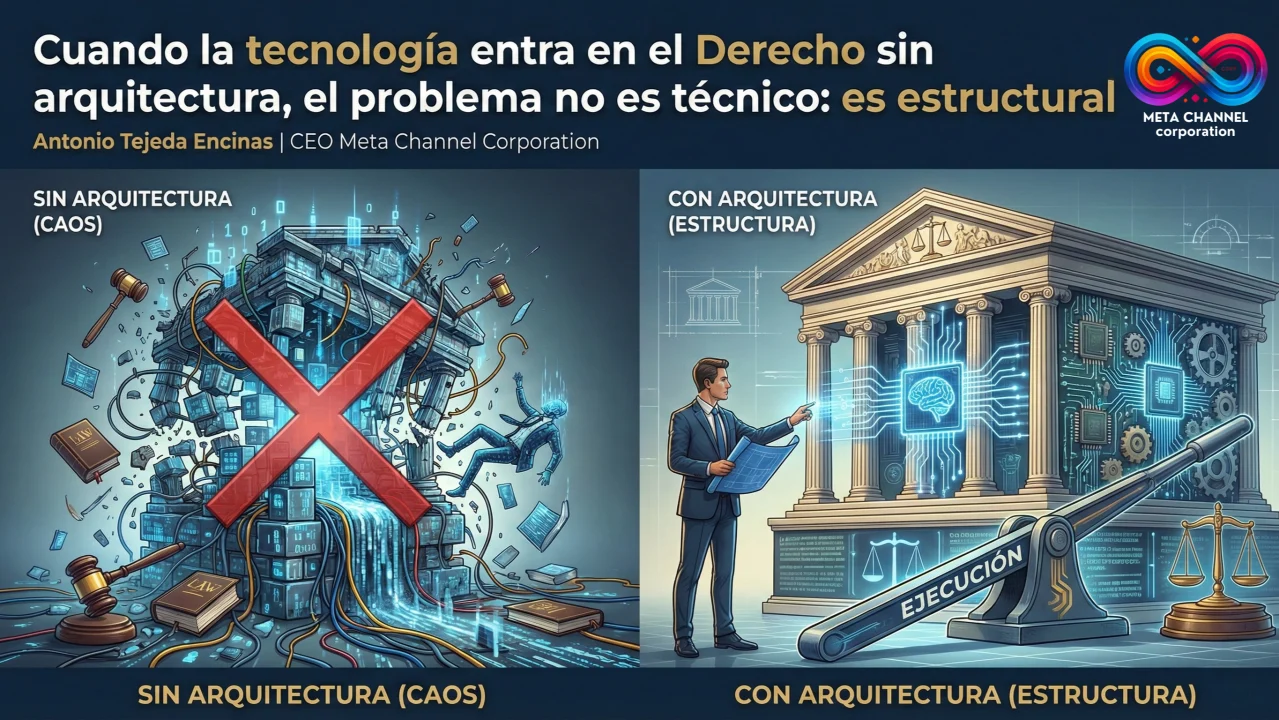
When technology enters the Law without architecture, the problem is not technical: it is structural
Antonio Tejeda Encinas | CEO META Channel Corporation
In recent months, a recurring debate has intensified in business and legal environments: to what extent technologies based on language models can be safely incorporated into legal, regulatory and strategic decision-making processes. The debate is usually articulated in instrumental terms, what tool, what model, what technique, and rarely addresses the question that really determines the result: the architecture from which they are integrated.
From META Channel Corporation We work precisely on that plane. Not in that of the tool, nor in that of technological fashion, but in that of how legal, regulatory and operational frameworks are designed that allow an organization to incorporate technology without compromising control, responsibility or regulatory compliance.
Experience shows that problems do not appear when a technology “fails”, but when it is introduced without a clear delimitation of functions, limits and consequences. In law, this is especially critical. Not because the Law is refractory to technology, but because it operates under principles, responsibility, traceability, regulatory hierarchy, imputation of decisions, which do not allow ambiguity.
That is why the real risk is not automation, but uncritical externalization of reasoning.
In regulated contexts, financial, technological, critical infrastructures, data, compliance, it is not enough for a result to be plausible or efficient. It must be defensible, audited, reconducible and attributable. Any system that participates in the generation of analysis, reports or decisions must be integrated into a chain where it is clear what is technical support, what is human decision and who is responsible for each phase.
This is the point where many organizations go wrong. Not because they adopt technology, but because they do without previously redesigning its legal and operational architecture. The result is a feeling of agility that, in reality, masks fragility: faster, but less controlled processes; more abundant outputs, but less verifiable.
META Channel Corporation does not act as a technology solutions provider or conceptual advisor. Act as executing arm: Designs, structures and implements architectures that allow operating in complex environments without losing control. This includes, where appropriate, the integration of advanced technology. But always like component subordinated to a prior legal framework, never as a substitute for it.
The parallel with task forces is only valid to a certain point. This is not a separation between analysis and execution, but rather a deliberately two-sided architecture. The Comité Euro Americano de Derecho Digital — CEA Digital Law and META Channel Corporation do not occupy different hierarchical levels, but rather complementary ones.
The Committee operates in the construction of the framework: research, legal reflection and conceptual standardization. META Channel Corporation operates in its deployment: structuring, implementation and execution in real environments, with clients, operations and assumed risk. They are not successive or accessory functions; They are two sides of the same coin.
This continuity explains the solidity of the structure since its origin. It is not born from the progressive accumulation of services, but from the prior design of a complete ecosystem in which thought and action are aligned from the beginning.
That is why our approach never starts from the question “what tool to use”, but from others that are much more uncomfortable and decisive: which jurisdiction is competent, what regulatory framework is applicable, what obligations are activated, what margins of interpretation exist, what risks are acceptable and which are not, and how the process is governed from beginning to end. Only when that map is defined does it make sense to talk about technology.
This is especially evident in areas such as DORA, NIS2, AI Act, MiCA or RGPD. They are not frameworks that allow improvisation. It is not enough to “comply”; one has to demonstrate how it is fulfilled, who guarantees it and how to react to failures. Integrating technology into these environments without first redefining the control architecture is an invitation to regulatory conflict.
Therefore, when META Channel Corporation accompanies a company in transformation, internationalization or regulatory adaptation processes, it does not implement tools. Implant structures. Legal, corporate, contractual, governance and liability structures. Technology is inserted later, and only to the extent that it reinforces that structure, not to the extent that it replaces it.
This approach has a direct consequence: not everything is automatable and not everything should be. There are decisions that, by their very nature, must remain under human control. Not for an abstract defense of the profession, but for reasons of legal imputation and responsibility. Technology can assist, accelerate and organize processes. It cannot assume the ultimate burden of the decision nor the responsibility that derives from it.
At this point it is important to be clear. The dominant discourse tends to present technology as a way to “reduce dependence on the expert.” In legal and regulatory environments, exactly the opposite occurs: The greater the technological integration, the greater the demand for expert judgment.. Because someone must design the framework, validate the output, assume responsibility and respond to third parties.
META Channel Corporation is positioned there. Not as a technological intermediary nor as a digital evangelizer, but as secure operating environment architect. Our role is not to explain how the tools work, but ensure that, when used, they do not go beyond the Law, the regulator or the client themselves.
From this perspective, the discussion about specific techniques, specific models or supposed comparative advantages is secondary. All technologies are potentially useful or potentially dangerous depending on the framework in which they are integrated. The determining factor is not the tool, but the structure that contains it.