
SJD / Dr. iuris Antonio Tejeda Encinas President Comité Euro Americano de Derecho Digital — CEA Digital Law | CEO META Channel Corporation
The problem is not the technology, it is the language
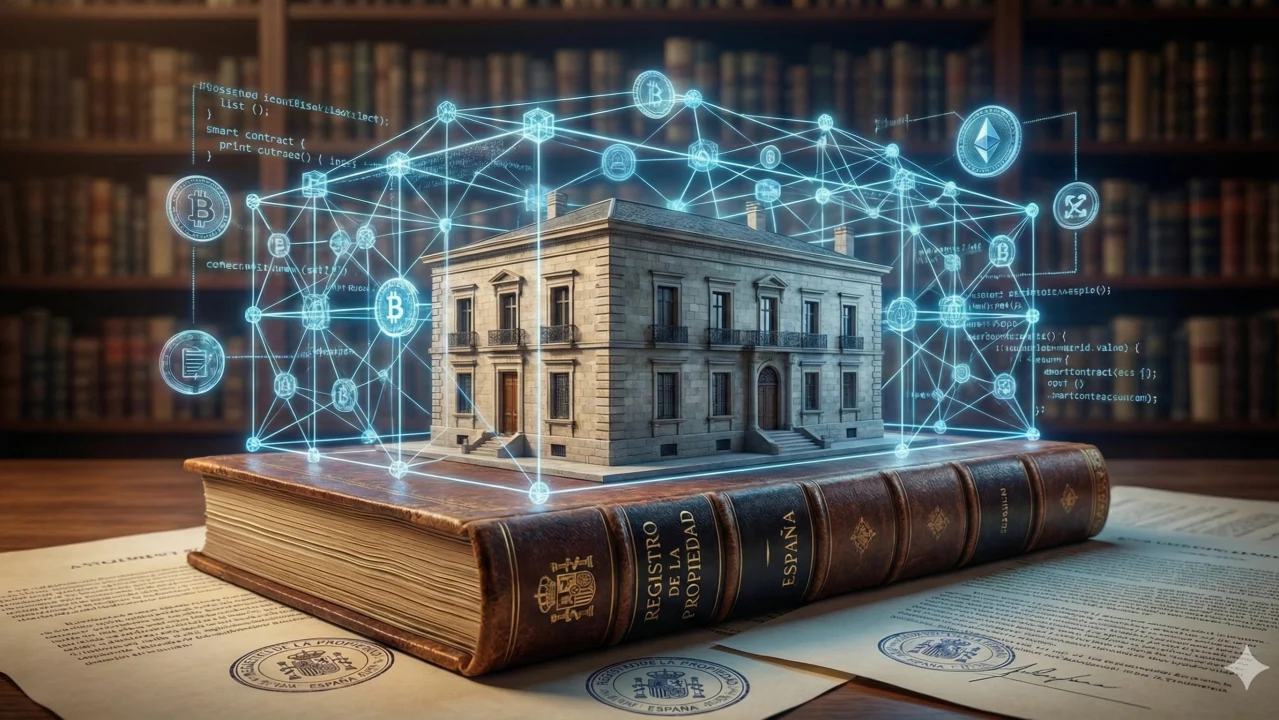
For years, the internet has been saturated with platforms and projects that claim to “tokenize real estate,” promising fractional ownership, instant liquidity and global access, as if the mere possession of a token was equivalent to ownership of a fraction of a real estate with full effects against third parties. This narrative, repeated in the crypto and real estate ecosystem, hides a serious conceptual error: it confuses the technological support of an operation with its legal validity, and this mismatch is generating misinformed investments, invalid structures and, in many cases, directly frauds.
The underlying problem is not that blockchain technology is ineffective. The blockchain works for what it was designed to do: prove that data was written at a given time and has not been altered. But this technical certification does not create real rights, does not transmit ownership and does not grant erga omnes opposability. In Spain, real estate property is only validly transmitted by public deed and, vis-à-vis third parties, with registration in the Property Registry; A token, by itself, does not produce real translational effects nor can it replace those requirements, because article 1280 of the Civil Code requires a public deed for the transfer of real rights over real estate and the Mortgage Law reserves to the Registry public faith and the protection of third parties in good faith.
What is possible, and it should be said without ambiguity, is to legally structure economic, credit or corporate rights linked to a property, always within the current civil, mortgage and financial framework. But then it is not the property that is being tokenized, but the legal structure that surrounds it: shares in a vehicle company, credit rights on income flows, participatory loans, real estate bonds or financial instruments subject to MiFID II or MiCA. That distinction is not an academic nuance, it is the border between what is legally possible and what is narratively profitable.
What really happens when someone says they tokenize a property
When a platform announces that it “tokenizes real estate,” in practice it is usually doing one of three things, none of which is equivalent to tokenizing real estate in a technical-registry sense.
First structure: proprietary vehicle company and equity tokens. The most common scheme is the creation of a vehicle company (SPV) that appears as the owner of the property in the Property Registry, while investors acquire tokens that represent shares, shares or economic rights linked to that company. The property remains registered in the name of the SPV; Tokens are, in legal terms, equity or quasi-equity. Platforms like RealT have popularized this model in the United States: each property is channeled through an LLC, the tokens represent shares and the income is distributed in cryptocurrency, but the registered owner of the property remains the company, not the diffuse set of token-holders. * The citations are as typological examples, not as a judgment of legality or legitimacy.
From the perspective of real estate law, the investor is not the owner of the property: he is a partner or participant in a legal entity that is. If the company is liquidated, bankrupt or subject to seizure, your position is that of a partner or, at most, a residual creditor. The blockchain does not alter that basic data.
Second structure: tokenization of credit rights and economic flows. Another variant is the tokenization of credit rights linked to the property: participatory loans, obligations, rental income or revenue sharing schemes. In this model, the token does not represent property or corporate participation, but rather a credit: the right to collect a part of the income or future capital gains. Reental, in its operations in Spain, is a paradigmatic example: investors acquire tokens that represent participatory loans to companies that operate real estate, receiving variable interests depending on the income and the eventual sale, but without acquiring any real right over the assets.
The framework is completely civil and financial: these are credits against a company or vehicle, possibly backed by guarantees, but the Property Registry continues to show the issuing company or a third party as the owner. The token holder is a creditor, not an owner; and if there is a conflict with a third party that registers a real right, the third party will prevail as a result of the public faith of the registry.
Third structure: economic fractionation disguised as digital property. The most problematic variant is the one in which a purely economic subdivision is marketed using the language of “ownership”, “shares of the property” or “fractional ownership”, when in reality what exists is a private contract with no real effectiveness against third parties or any reflection in the Registry. In these cases, the investor purchases a token that incorporates a promise to participate in income or capital gains, but does not acquire any real right or title that can oppose seizures, mortgages or subsequent registered transfers.
This third group is the area where it is easiest for marketing to become a scam. The investor believes he is buying “a part of the floor”, but legally he only has a contingent credit against an issuing entity, normally located in another jurisdiction and, often, with little regulatory supervision. The blockchain does not add legal protection: it simply records the existence of a token that no public registry recognizes as a title.
Why the token cannot be a real estate title
The reason why the token cannot become an autonomous title to real estate property today has nothing to do with the technical capabilities of the blockchain and everything to do with the structure of real estate law as a law of public order.
In the Spanish system, the property purchase and sale contract can be formalized in a private document, but the transfer of ownership with full effect requires a public deed and, for its effectiveness against third parties, registration in the Property Registry. Article 1280 of the Civil Code requires a public deed for the transfer of real rights over real estate, 609 CC combines title and mode, and the Public Deed can serve as an instrumental traditio according to article 1462 CC. In turn, the Mortgage Law configures the Registry as the axis of the system: registration is not constitutive in any case, but it is decisive for the protection of the third party in good faith and to provide stability to legal traffic.
The blockchain cannot perform these functions because it lacks the features defined by the regulations: there is no public authority responsible for the entry, there is no prior legality control, there is no registration qualification, there is no priority system or public faith, nor an institutionalized mechanism for rectification of errors and nullities. What technology offers is proof of integrity, not legal legitimacy. Recording in the blockchain that A “transfers” a token to B does not make B the registered owner of the property that that token supposedly represents; makes him, in the best of cases, the holder of an obligatory right against the issuer of the scheme.
This logic is not exclusive to Spain. It is part of an institutional design that no moderately serious State has abandoned, not even those that have been experimenting with blockchain in public records for years.
Comparative law does not deny, it confirms
In comparative terms, the panorama is uniform: no country has converted the token into an autonomous title of real estate property with constitutive effectiveness; At best, it has put blockchain at the service of the registry, not in its place.
In Sweden, the Lantmäteriet project tested the digitalization of the transmission process on blockchain, with the aim of reducing time and costs, but the translational efficiency still depended on the state registry: the technology was used as the infrastructure of the procedure, not as a substitute for the registry system or as an autonomous source of real rights.
In Georgia, property titles are anchored to the blockchain to reinforce integrity and traceability, through projects initially developed with Bitfury and, more recently, with agreements to explore tokenization on Hedera, but the constituent authority remains the National Agency of Public Registry; There is no regime in which the mere transfer of a token, outside of registration, produces erga omnes effects on land ownership.
In Dubai, the Dubai Land Department has launched “property tokens” and fractional investment platforms in collaboration with private companies, using blockchain as support, but valid ownership remains that recognized by the Emirati real estate registry: the token operates as an authorized reflection of the registry entry and as a financial vehicle, not as an autonomous title that displaces the registry.
Far from denying the thesis, comparative law reinforces it. The global movement is in the direction of better recording, not of dispensing with recording.
The structural confusion: digital will, smart contracts and DAOs
The fiction of “native blockchain ownership” of real estate repeats a pattern that has already been seen in other areas: the “digital will”, the “smart contracts that replace the notary” or the “DAOs that own real estate” without recognized legal personality. In all of them, technological enthusiasm tends to ignore that there are matters that the regulations do not leave at the disposal of private autonomy or of mere technology, even if this works impeccably. You can read my latest article about the digital establishment here
In all these cases, the underlying error is the same: confusing technological support of the will with legal validity of the will. Inheritance law, real estate law and the regime of real rights are not a problem of lack of technology; They are instruments of public order aimed at protecting third parties, ensuring traffic stability and channeling private autonomy through controlled forms.
When limits are ignored, there is no innovation: we go outside the law
Real estate tokenization can bring efficiency, transparency and new forms of access to investments, but only if it is built on the correct legal architecture. When the blockchain is presented as a substitute for the Property Registry, when it is promised that a token “is” the property of the property without public deed or registration, when fractions of something that the system does not recognize as real right are sold, there is no innovation: there is an exit from the legal system and massive exposure to risk.
In Spain, as in the rest of advanced jurisdictions, the underlying message is simple and should be formulated bluntly: Without Registration there is no real estate property, and without ownership there is no transmission. Technology can improve the channel, never eliminate it. And at that limit, rather than in the uncritical celebration of “everything is tokenized,” is where the difference between an ecosystem that innovates within the Law and a market that lives on conceptual fictions that will end up being resolved in the courts is played out.
* The citations are as typological examples, not as a judgment of legality or legitimacy.