
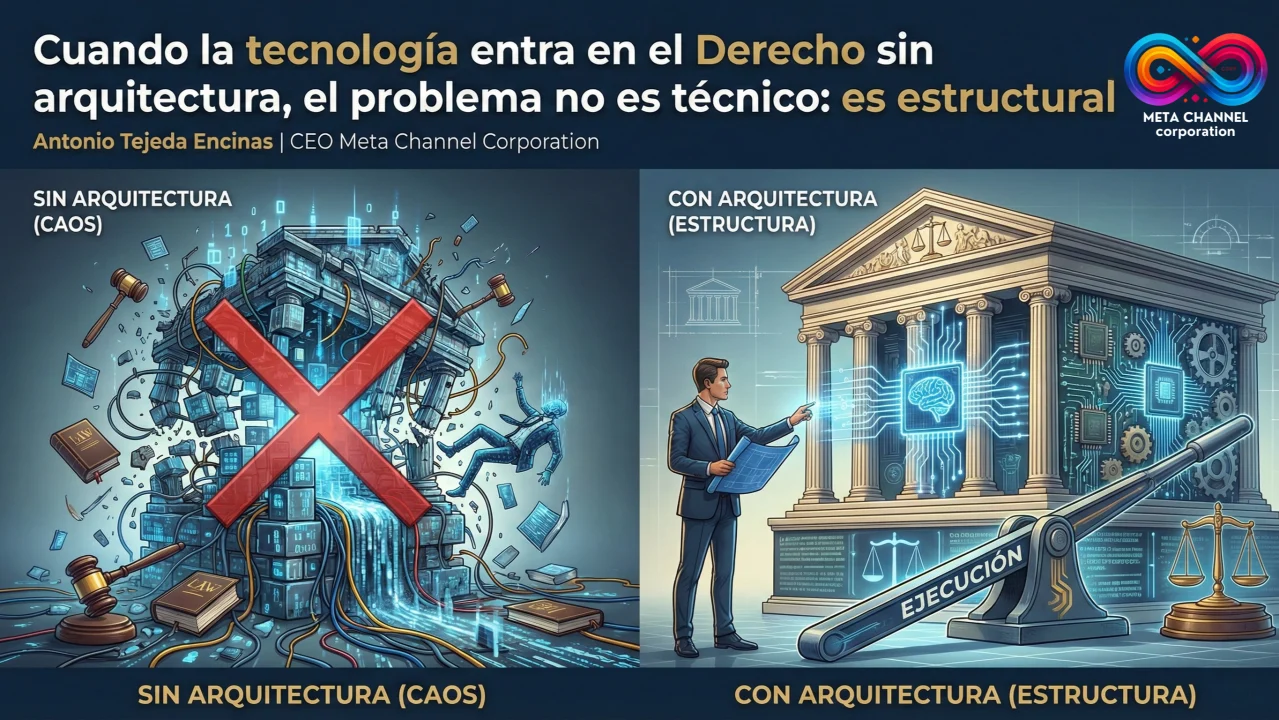
When technology enters the law without architecture, the problem is not technical but structural
Antonio Tejeda Encinas | CEO META Channel Corporation
In recent months, a recurring debate has intensified in business and legal circles: to what extent can technologies based on language models be safely incorporated into legal, regulatory and strategic decision-making processes? The debate is usually framed in instrumental terms (which tool, which model, which technique) and rarely addresses the question that actually determines the outcome: the architecture within which they are integrated.
At META Channel Corporation, this is precisely the level at which we work. Not at the level of the tool or of technological fashion, but at the level of how legal, regulatory and operational frameworks are designed so that an organisation can adopt technology without compromising control, accountability or regulatory compliance.
Experience shows that problems arise not when a technology “fails”, but when it is introduced without a clear definition of functions, limits and consequences. In law, this is especially critical. Not because the law is resistant to technology, but because it operates on principles (responsibility, traceability, the hierarchy of norms, the attribution of decisions) that do not allow for ambiguity.
That is why the real risk is not automation, but the uncritical outsourcing of reasoning.
In regulated settings (finance, technology, critical infrastructure, data, compliance), it is not enough for a result to be plausible or efficient. It must be defensible, audited, correctable and attributable. Any system involved in producing analyses, reports or decisions must be built into a chain in which it is clear what is technical support, what is human decision and who answers for each stage.
This is where many organisations go wrong. Not because they adopt technology, but because they do so without first redesigning their legal and operational architecture. The result is a sense of agility that in fact masks fragility: processes that are faster but less controlled; outputs that are more abundant but less verifiable.
META Channel Corporation does not act as a technology solutions provider or as a conceptual adviser. It acts as an implementation arm: it designs, structures and implements architectures that make it possible to operate in complex environments without losing control. Where appropriate, this includes the integration of advanced technology, but always as a component subordinate to a prior legal framework, never as a substitute for it.
The parallel with task forces holds only up to a point. This is not a separation between analysis and execution, but a deliberately two-sided architecture. The Euro-American Committee of Digital Law (CEA Digital Law) and META Channel Corporation do not sit on different hierarchical levels, but on complementary ones.
The Committee works on building the framework: research, legal reflection and conceptual standardisation. META Channel Corporation works on deploying it: structuring, implementation and execution in real environments, with clients, operations and real risk taken on. They are neither successive nor ancillary functions; they are two sides of the same coin.
This continuity explains the solidity of the structure from the outset. It did not emerge from the gradual accumulation of services, but from the prior design of a complete ecosystem in which thought and action have been aligned from the start.
That is why our approach never starts from the question “which tool should we use?”, but from others that are far more uncomfortable and decisive: which jurisdiction is competent, which regulatory framework applies, which obligations are triggered, what room for interpretation exists, which risks are acceptable and which are not, and how the process is governed from start to finish. Only once that map has been drawn does it make sense to talk about technology.
This is especially evident in areas such as DORA, NIS2, the AI Act, MiCA and the GDPR. These are not frameworks that tolerate improvisation. It is not enough to “comply”; you have to show how compliance is achieved, who guarantees it and how failures are dealt with. Integrating technology into these environments without first redefining the control architecture is an invitation to regulatory conflict.
That is why, when META Channel Corporation supports a company through transformation, internationalisation or regulatory adaptation, it does not implement tools. It implements structures: legal, corporate, contractual, governance and liability structures. Technology comes in afterwards, and only to the extent that it reinforces that structure, not to the extent that it replaces it.
This approach has a direct consequence: not everything can be automated, and not everything should be. There are decisions that, by their very nature, must remain under human control. Not out of an abstract defence of the profession, but for reasons of legal attribution and liability. Technology can assist, speed up and organise processes. It cannot bear the ultimate burden of the decision, nor the responsibility that flows from it.
At this point it is worth being clear. The prevailing narrative tends to present technology as a way of “reducing dependence on the expert”. In legal and regulatory environments, exactly the opposite happens: the greater the technological integration, the greater the need for expert judgement. Because someone has to design the framework, validate the output, take responsibility and answer to third parties.
That is where META Channel Corporation stands. Not as a technology intermediary or a digital evangelist, but as an architect of secure operating environments. Our role is not to explain how the tools work, but to ensure that, when they are used, they do not overwhelm the law, the regulator or the client.
From this perspective, the discussion about specific techniques, specific models or supposed comparative advantages is secondary. All technologies are potentially useful or potentially dangerous depending on the framework in which they are integrated. The determining factor is not the tool, but the structure that contains it.