By Dr. Antonio Tejeda Encinas CEO, META Channel Corporation President, Comité Euro Americano de Derecho Digital — CEA Digital Law
1. The starting point: Securitize, the CNMV and the superficial reading of the milestone
The CNMV’s authorization of Securitize as a DLT Trading and Settlement System under Regulation (EU) 2022/858 has been received as confirmation that “the tokenized exchange” is already a reality in Spain. It is a relevant step: for the first time, a DLT infrastructure combining negotiation and settlement receives the green light in our country.
The problem is not in the CNMV’s decision. The problem is how it is being read.
This milestone is being presented as if it were enough to affirm that the Spanish ecosystem already has a mature framework to “tokenize anything”, in any way and at any phase. And it’s not like that. The existence of an infrastructure does not, by itself, resolve the decisive question: how the asset that is uploaded to that infrastructure is structured.
2. The conceptual error: confusing the secondary market with the architecture of the asset
The current euphoria revolves around the secondary market: listing, trading, liquidity, accessibility.
But this entire layer rests on a previous question that is rarely formulated clearly:
What right is the investor acquiring exactly when they buy that token?
If the answer is not legally protected, it does not matter whether the token is traded on a SNL DLT, on a traditional MTF or on a “democratizing” platform. We will continue talking about fragile structures, exposed to regulatory, fiscal and reputational problems.
Technology solves transmission. The legal architecture resolves the content. And right now the market talks a lot about the first and very little about the second.
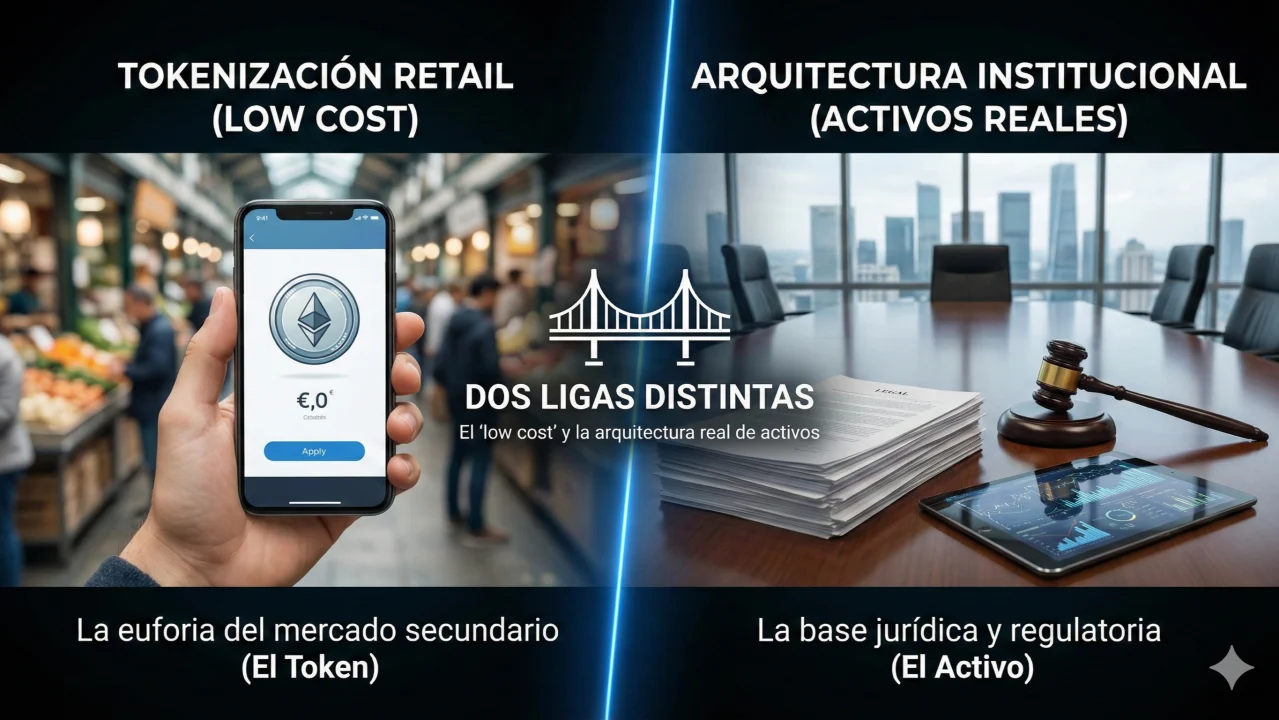
3. Two different leagues: retail democratization vs. institutional structuring
Today, in fact, two different logics coexist.
On the one hand, a democratizing logic, aimed at the retailer, that allows participating in operations with tickets of 50, 100 or 500 euros. Its value is clear: it opens doors for those who would never have accessed certain assets.
On the other hand, an institutional or quasi-institutional logic, where we talk about operations of 5 to 50 million (or more), with issuers that do not seek to “democratize” anything, but rather optimize structures, diversify financing, integrate the digital layer into already regulated ecosystems and do so without generating a problem with their supervisor, their auditor or their international parent company.
According to recent data, the global tokenized asset market will reach $24 billion in 2025, growing by 308% in three years. Standard Chartered projections estimate that it could reach 30 trillion by 2034. This expansion does not eliminate the need for solid legal architecture. It amplifies it.
The error of current discourse is treating both worlds as if they were interchangeable. They are not. They share the word “token”, but live in completely different legal, economic and reputational frameworks.
4. The “low cost” of tokenization: useful, but not transferable to any scenario
In Spain and other markets, very effective low-cost tokenization models are being consolidated. They simplify entry, reduce costs, shorten terms and allow small investors to access fractions of assets that were previously out of reach.
That’s positive. But he is positive in his league.
The problem begins when one attempts to transfer that same approach to operations that involve several jurisdictions, require cascading corporate structures, are inserted in heavily regulated sectors (energy, financial, audiovisual) or generate economic flows that intersect with different tax systems.
Pretending that a complex operation be resolved under the same logic as the purchase of 100 euros of “a piece of tokenized apartment” is a dangerous fiction.
5. The real core: the asset, not the token
A token is a technical interface. It is not the asset. It’s not the operation. It’s not the business.
When someone buys a token, they are actually buying a legal position within a specific structure, with a specific tax regime, an expectation of rights (collection, participation, use, access) and a scheme of guarantees, governance and responsibility behind it.
If that structure is not solidly defined, the token can circulate very quickly… towards a conflict.
The obsession with “technological innovation” has created the illusion that the problem is choosing the right blockchain, the right token standard, or the friendliest platform. In the institutional segment, this is secondary. What is decisive is what the token represents and how it is given legal and regulatory life.
6. MiCA is not a haven for any real asset token
Since the approval of MiCA, a dangerous narrative has been installed: the idea that there is a large space of “non-financial cryptoassets” where everything fits as long as it is not called “tradable security.”
It is a misreading.
MiCA applies to cryptoassets that are not financial instruments. But if the token design promises performance, links the economic success of the investor to the success of the issuer, offers credit or participation rights, or replicates behaviors typical of a security, the perimeter is not MiCA, but MiFID II / Securities Market Law.
Thus, many projects that today are sold as “utility tokens linked to real assets” are not actually in the MiCA space, but rather bordering—or directly within—the perimeter of tradable securities. And that difference cannot be resolved with slogans.
7. The Spanish case: what a well-made broadcast teaches (really)
The example of issues like Dianelum, with authorized ERIR, SaaS platform, securities agency and professional custody, does not prove that “anyone can tokenize.” Prove the opposite.
It demonstrates that a solid legal architecture has been necessary, fine coordination between the platform, ERIR, custodian and legal advice, and a clear fit within the Securities Market Law.
That is to say: a serious broadcast returns us to the starting point. To issue a legally sustainable tokenized asset, the critical question is not “what network do we mount it on?”, but “what exactly are we issuing and under what regime?”
8. Who serves the complex space today… and where there is still space
It would be false to claim that the 5–50 million trading space “is not covered by anyone.” It would be equally naive to deny the role of large international firms, integrated platforms and high-level boutiques.
That fabric exists. And in many cases it works well.
Where there is still a gap is in a specific area: operations that cross several jurisdictions in a non-standard way (Europe–Latam–Africa), combine financial regulation with sectoral regulation (energy, audiovisual, data economy), require an institutional and geo-technopolitical reading, and need a flexible architecture agreed upon with several counterparties.
In these projects, traditional vertical structures—very powerful in their natural scope—do not always offer the agility and multi-level coordination necessary when the operation is still in the conception phase.
There it makes sense to talk about strategic architecture as a differentiated function.
9. Where is META Channel Corporation located on this map
META Channel Corporation is not a tokenization platform, nor a market infrastructure, nor an SNL, nor a SaaS provider that competes with Securitize, Token City or other players in the ecosystem.
Nor is it presented as an alternative to large firms or the Big Four in their natural field.
Its function, through the division TokenLab™ by META Channel Corporation, It is placed before the choice of platform or infrastructure. The focus is on the design of the operation, not its technological execution.
In functional terms, META Channel Corporation:
Designs legal and corporate architectures for projects that contemplate the tokenization of real assets;
analyzes the regulatory fit (LMV/MiFID, MiCA, sectoral regulation, private international law);
structures corporate governance and agreements between partners, investors and operators;
coordinates the tax layer in multi-jurisdictional environments;
and prepares the asset so that tokenization—if applicable—is inserted into a legally sound structure.
META Channel Corporation does not act as a provider of all “in-home” services. Operates as a strategic architect and orchestrator, coordinating technical, fiscal, sectoral and technological specialists according to the needs of each project.
Geographic focus: the work may or may not be concentrated, depending on the client, on connecting the Canary Islands as a technological and fiscal hub with emerging markets in Colombia, Angola and countries in the Southern Cone, taking advantage of the frameworks of the Canary Islands Economic and Fiscal Regime (ZEC, RIC) and its strategic position between Europe, Africa and Latin America.
META Channel Corporation does not sell “tokenization”. Sell structure: the design of the asset, the vehicle and the operation so that tokenization, when it makes sense, is possible, secure and scalable.
10. Return to the initial question
The authorization of Securitize as SNL DLT is not the end of anything. It is the beginning of a stage where it will be clearly seen who has understood that the center of gravity is in the asset and its architecture, and who has remained trapped in the fascination with the token and the marketplace.
Low cost has its function. Democratize access. Generates financial culture. Open doors. But it cannot become the mental model for designing complex operations in transnational environments.
In that segment, the question is not “where do we list the token?”, but rather “what exactly have we designed to make it meaningful to list it?”
About the author
Dr. Antonio Tejeda Encinas is CEO of META Channel Corporation, a Praxis House specialized in integrating law, strategy and technology for transnational operations. META ChannelCorporation operates in three main areas: legal and corporate architecture in Europe–Latam–Africa environments; strategy and regulatory compliance in disruptive technologies (MiCA, AI Act, DORA, NIS2, RGPD); and development of technological solutions applied to compliance (RegTech and GovTech). META Channel is not a tokenization platform. The TokenLab™ by META Channel division acts as a specialized unit in the prior legal-regulatory design for real assets that may become tokenized, ensuring their compatibility with European and extra-European frameworks.
Dr. Tejeda Encinas also chairs the Comité Euro Americano de Derecho Digital — CEA Digital Law, an international network present in 25 countries dedicated to digital governance, data diplomacy and legal-technological research.