This document arises from a frustration shared by investors and entrepreneurs: the systematic disconnection between available capital and the business projects that should receive it. Orbital Investment & Execution Hub exists precisely because that problem is real. We were not born to cover a niche detected in a theoretical study, but to respond to a tension that we have been experiencing—and continue to experience—both investors and entrepreneurs in the tricontinental space between Europe, Africa and Latin America. From our position as a private investment and execution infrastructure, operated by META Channel Corporation, we have had privileged access to both sides of the table. We have seen institutional investors with committed capital and without the ability to deploy it due to a lack of projects that meet their minimum analysis standards. And we have seen companies with real business, demonstrable traction and scale potential that fail to cross the threshold of institutional investment because they lack the legal, financial and governance architecture that capital demands. This article documents that problem with the rigor it deserves. Analyzes its structural causes, maps the actors that operate in the ecosystem and their limitations, and explains why the solution does not involve more acceleration, more networking or more pitch events, but rather a different type of infrastructure that assumes real responsibility for the transition between company and investable asset. That infrastructure is what we have built. And this analysis explains why.
Capital without destination, projects without financing: the structural failure that no one is solving
The investment ecosystem in Spain and Europe is going through a paradox that few dare to name clearly. According to recent data, Spain now has more than 1,400 venture capital entities registered with the CNMV, compared to the 600 that existed in 2020. The assets under management in private equity exceed 70,000 million euros. The large family fortunes—the historic ones and the new ones—have established their own investment vehicles seeking diversification beyond traditional real estate and tax efficiency.
And yet, capital has nowhere to go.
The comfortable narrative that has been repeated for years is simple: if companies do not get investment it is because there is a lack of capital; If investors do not invest it is because there is a lack of good projects. Both statements are false. And the most worrying thing is that this falsehood has become normalized to the point of becoming commonplace.
Investor frustration: excess noise, shortage of investable projects
From the capital side, the diagnosis is reiterated and consistent across all investor types. Spanish family offices – which according to the OpenWealth and finReg360 report allocate approximately 10% of their assets to investment in startups and growing companies – operate with average structures of four to six people. They do not have the capacity to analyze the volume of projects they receive. 57% of them do not even have a defined follow-on policy: they act according to the circumstances because they do not have the resources to systematize their investment process.
Their discard criteria are revealing: poorly solvent teams, high ratings, unoriginal ideas. But the underlying problem is not the intrinsic quality of the projects – many have real potential – but rather their presentation and structuring. 66% of these family offices outsource legal advice and 61% outsource tax advice, which indicates that they do not have the internal capacity to evaluate the legal and regulatory soundness of the opportunities they receive.
Venture capital funds suffer a similar reality, aggravated by the pressure of their own cycles. Many manage portfolios of investees acquired in previous years that they are unable to divest. The exits market is slowing down. They need projects with demonstrable traction, but what they receive are presentations without validated metrics, without due diligence prepared, without optimized corporate structure. A fund like Encomenda Capital has publicly acknowledged that it rejects 99% of the startups it analyzes.
Even business angels, more agile and willing to take on greater risk in early phases, need a minimum: a solvent team, a differential idea, a model with scale potential. What they often find are unvalidated concepts, financial projections that do not withstand scrutiny, and founders who do not understand the language of capital.
Investing frustration is not risk aversion—risk is inherent to investment—but poorly managed uncertainty. It’s not that the project is risky; It is that it cannot be evaluated if it is because it arrives without the minimum structure to be analyzed.
The business perspective: available capital that never arrives
From the companies’ side, the complaint is reverse but complementary. There is money available, but not for them. Many founders feel like they are knocking on doors that never open, without fully understanding what they are missing.
The reality is harsh: it is not enough to have a good idea or even a good product; You have to know how to present it and structure it as an investment opportunity. And this is where the majority shipwreck.
A recent study of SMEs in comparable markets identified the main internal obstacles: poor administrative and financial control in 42% of cases, poor communication strategy in 20%, and a weakly articulated business model in 14%. They are deficiencies of origin that undermine investor confidence before they can even evaluate the potential of the business.
The seed-stage startup has an idea and little else. No validated product, no recurring customers, no cash. Your only real option is FFF funds (family, friends, fools) or business angels willing to bet on the team. It is not ready for institutional capital nor should it be yet. But many try to skip that phase, applying to funds that cannot and should not serve them.
The early-stage company already has a product and its first customers. But he doesn’t know how to speak the investor’s language. Terms like runway, CAC, LTV, vesting or liquidation preferences sound like foreign jargon to you. It does not have due diligence prepared, nor an optimized partner agreement, nor financial projections that withstand professional scrutiny.
The SME with a proven track record has real traction, but has never considered raising external capital. He doesn’t know what he’s missing. When you approach a fund, you discover that its documentation does not meet the minimum standards of analysis. Obsolete corporate bylaws, non-existence of shareholders’ agreements, unregistered intellectual property, informal labor practices. These are aspects that a due diligence process will immediately bring to light.
And then there is the Latin American or African company that wants to access the European market. It has a proven business at origin, a competent team, real clients. But he is unaware of European regulation: AI Act, MiCA, DORA, ZEC structures, RIC incentives. For the European investor, it is invisible or inaccessible.
A problem that transcends borders
This mismatch is not exclusive to Spain. The same pattern is repeated in multiple geographies.
In Europe, despite its economic maturity, early investment remains significantly lower than in the United States. Many European investors point out that ideas and talent abound, but when push comes to shove, there is a lack of teams prepared to scale globally and truly differentiated business models. The consequence: a lot of European capital ends up investing in Silicon Valley or in very consolidated projects, skipping the initial local stages.
In Latin America, with emerging ecosystems and growing capital—venture capital investment in the region tripled between 2020 and 2021, reaching $19.5 billion—the same symptom also emerges. Networks of angel investors indicate that the problem is often not liquidity, but rather finding structured ventures prepared to receive investment. The funds end up all competing for the same few startups that do gather traction and
formality, while dozens of potential ventures die in early stages.
In Africa, the situation repeats the trend with additional aggravations. Global investors interested in African markets complain about the lack of projects with proper formalization. Paradoxically, significant amounts of funds have been mobilized for the continent in recent years, but many end up underutilized or concentrated only in top-tier startups. Organizations like the IFC have launched programs specifically to build a pipeline of investment-ready projects, recognizing that the bottleneck is not necessarily a lack of money.
Globally, the recent abundance of liquidity has further exposed this paradox: an excess supply of capital and a shortage of qualified opportunities. Even in 2024-2025, with corrections in technology valuations, large international funds indicate that they continue to find fewer solid companies than necessary to deploy all the committed capital.
The structural failure: a market designed to fail in the transition
The problem is not temporary. It’s architectural.
The current ecosystem is reasonably designed for two specific moments in the business cycle. It works when the company is already fully institutionalized and can undergo a standard due diligence process. And it works when the investor enters late phases, with already limited risks and verifiable metrics.
But it systematically fails in the transition between a real company with a business and an investable asset to an institutional standard.
That stretch—uncomfortable, expensive, intensive in structure—is today abandoned to improvisation. Companies reach institutional capital too soon. Investors enter the value chain too late. And between the two there is no stable infrastructure that assumes the responsibility of converting business into investable assets.
The actors of the ecosystem and their structural limitations
To understand why this gap persists, it is necessary to analyze what each type of actor does in the ecosystem and where their function stops.
Traditional accelerators
Accelerators were born to solve part of the problem: take startups in a very early stage and prepare them to raise their first round. Programs like Y Combinator, Techstars or Wayra have shown that the model can work. According to data from the Global Startup Studio Network, going through a good accelerator can increase the probability of raising seed capital by approximately 20%.
But the model has structural limitations. The accelerators operate in cohorts with a defined time horizon: three months, six months, culminating in a Demo Day. After that event, institutional support is diluted. The startup is left alone looking for investment, with the tools it has acquired during the program but without continued support.
Furthermore, accelerators focus almost exclusively on very early-stage technology startups. They do not serve established SMEs that need to restructure to raise capital. They do not serve international companies that need European architecture. They do not serve the middle section of the cycle, where the business already exists but institutionalization is lacking.
And they assume no significant risk of their own. Its business model is based on taking small stakes in exchange for a program and hope for future upside, not on investing substantial resources in the prior structuring of each project.
Venture Studios
Venture studios represent a significant evolution of the model. Actors like Atomic, Flagship Pioneering, eFounders (Hexa) or Rocket Internet do not accelerate startups: they create them from scratch. They provide the idea, founding team, initial capital and operational resources. The results are notable: according to the 2022 GSSN report, startups born in venture studios have approximately a 30% higher success rate than traditional ones. 84% obtain seed financing, 72% reach Series A (compared to 42% of conventional startups), and the time until Series A is reduced from 56 months to 25 months.
But venture studios have a specific scope: they create new companies. They do not work with companies that already exist. Their model requires control from the beginning — they come up with the idea, they select or contribute the founders, they define the structure from day one. An SME with five years of experience and 2 million in turnover does not fit into a venture studio because the venture studio does not enter into projects that it has not created itself.
In addition, the main venture studios operate in mature markets – the United States, Western Europe – and in specific technological sectors. The tricontinental space between Europe, Africa and Latin America remains outside its operational radar.
Advisors and strategic consultancies
The ecosystem is populated by advisors, fundraising consultants, M&A boutiques and strategy firms that offer services to companies seeking capital. Their proposal is legitimate: they provide experience, contacts, methodology.
But they operate under a transactional model. They charge per project, per hour or per success of the round. They are not integrated into the company. They do not assume prior structural risk. If the company fails to raise the round, the advisor charges less or does not charge, but has not invested its own resources in preparation. Their incentives are aligned with the closing of the transaction, not necessarily with the structural soundness of the project.
Furthermore, their service is fragmented. A fundraising advisor does not carry out corporate restructuring. A commercial lawyer does not prepare the model
financial. A strategy consultant does not manage regulatory compliance. The company ends up coordinating multiple suppliers without an integrated vision, and frequently without the criteria to know if what they are delivering is sufficient for the standard of the investor to which it aspires.
Crowdfunding and equity crowdfunding platforms
Platforms such as Crowdcube, SeedBlink or Republic have democratized access to investment in startups. They allow companies to raise capital from a broad base of small investors, reducing dependence on traditional gatekeepers.
But their model is exactly the opposite of qualitative filtering. They are marketplaces: the more companies listed, the more commissions they generate. The due diligence they carry out is basic, aimed at minimum legal compliance rather than validation of investment quality. The investor on these platforms takes responsibility for their own analysis, often without the tools or information to do it well.
For the institutional investor—family office, venture capital fund—these platforms do not solve anything. They don’t want access to a marketplace of unfiltered projects; They want qualified, validated, structured deal flow. Crowdfunding platforms serve a different segment of the market: the retailer who wants exposure to startups with small tickets.
Business angel networks and investment clubs
Angel networks—EBAN in Europe, Keiretsu Forum, local networks such as BIGBAN in Spain—group individual investors seeking dealflow and co-investment. Their value is in aggregation: they allow a project to access multiple potential investors in a single process.
But these networks do not prepare projects; They exhibit them. A project that reaches an angel network must already come structured and ready to present. If it’s not, the network doesn’t fix it—it simply rejects it or lets it languish without attention. The function of the network is to connect, not to build.
Furthermore, business angels operate on relatively small tickets – typically between 25,000 and 250,000 euros – and in very early phases. They do not cover the needs of a company seeking a round of 2 million for international expansion, nor do they have the structure to validate complex corporate operations.
Public incubators and institutional programs
Governments and public entities have multiplied programs to support entrepreneurship: university incubators, ENISA programs, regional business development initiatives, European funds channeled through multiple instruments.
These programs serve a valuable social function, but are not designed to produce institutional quality projects. Its selection criteria prioritize territorial impact, job creation or alignment with public policies, not necessarily investment viability. Their technical teams often lack
of experience on the equity side—they haven’t worked in funds, they haven’t done professional due diligence, they don’t know private market standards.
The result is that many companies leave public incubators with a false sense of being “ready” for investment, when what they have is preparation for subsidy. They are different languages, different standards, worlds that barely touch each other.
The void that no one occupies
If we map the entire ecosystem, the pattern is clear. Accelerators work with very early startups and release after Demo Day. Venture studios create new companies but do not work with existing companies. Advisors advise by project without integration or shared risk. Crowdfunding platforms are marketplaces without qualitative filtering. Angel networks connect but do not build. Public incubators prepare for subsidies, not for investment.
Who assumes the responsibility of taking a company with a real business—not an idea, not a PowerPoint, but a functioning company—and turning it into an investable asset at institutional standards?
Who does the complete corporate structuring, the shielded shareholders’ agreement, the auditable financial model, the verified regulatory compliance, the professional investment narrative, the pre-packaged due diligence — and does it in an integrated way, with investor criteria, assuming its own risk in the process?
Almost no one. That section of the market is abandoned to the improvisation of each individual company, with the results that we all know: projects with potential that never reach capital because no one took them to the threshold.
The conceptual error: confusing preparation with responsibility
For a long time it has been assumed that the solution was to “better prepare companies.” Coaching for founders. Pitch workshops. Mentoring on finances. Timely legal advice.
That’s only part of the problem—and not the decisive part.
The problem is not that companies do not know how to present themselves. The problem is that no one institutionally assumes responsibility for making the project investable.
Preparing is not the same as integrating. Advising is not the same as executing. Connecting is not the same as structuring. Selecting is not the same as assuming prior risk.
As long as capital continues to wait for completed projects and companies continue trying to reach that threshold alone, the failure will persist. The market needs something different: no more fragmented preparation, but rather an institutional architecture that assumes the transition as its own responsibility.
Orbital Investment & Execution Hub: architecture for the structural void
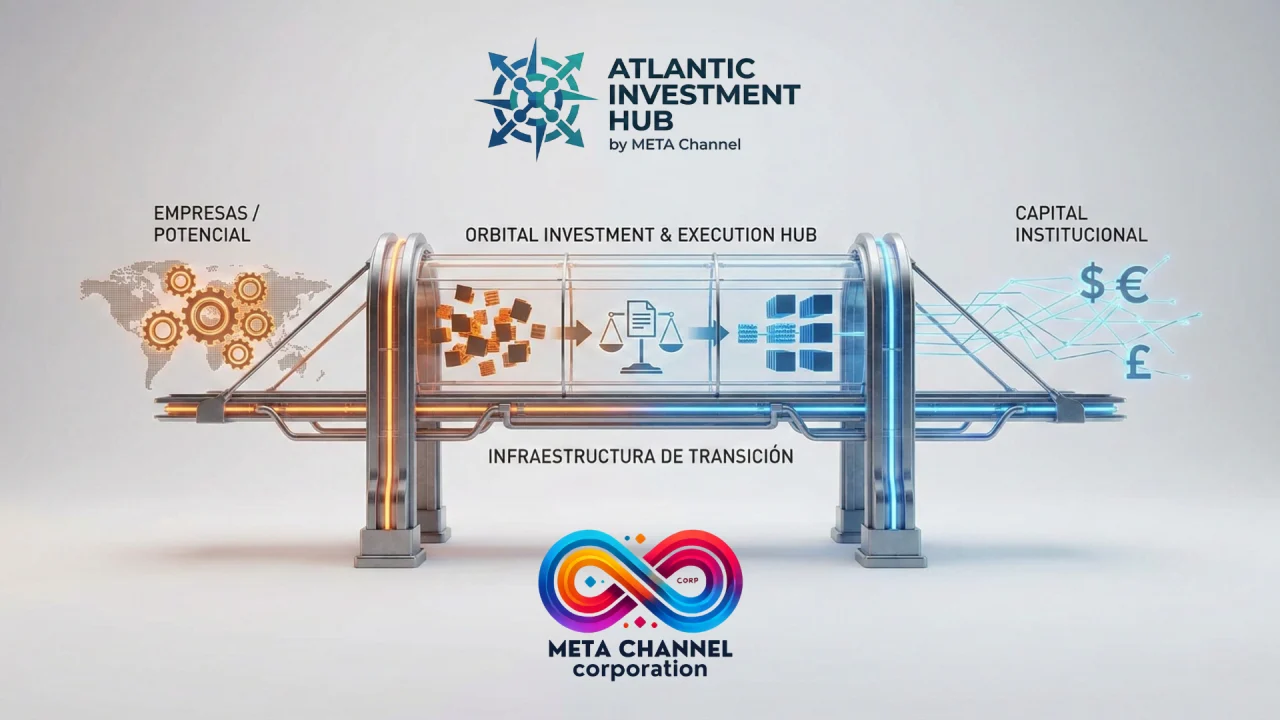
It is in this context where Orbital Investment & Execution Hub positions itself—not as just another accelerator, nor as a fund, nor as a consulting firm, but as what the market really needs: permanent structuring and connection infrastructure between companies with real business and qualified institutional investors.
Orbital is a specialized division of META Channel Corporation, operating from Ireland and the Canary Islands, with tricontinental reach: Europe, Africa and Latin America. It is not a program with a start and end date. It is not an annual networking event. It is not a marketplace where any project can be listed. It is institutional infrastructure designed to solve the structural problem that we have described.
What Orbital does
Orbital operates in the segment that no one covers: it takes companies that already have real business—billing, clients, demonstrable traction—but that lack the institutional architecture necessary to access qualified capital, and transforms them into investable assets at market standard.
This involves comprehensive structuring work that includes: review and optimization of the corporate structure, design and implementation of partner agreements with standard investment clauses, preparation of auditable financial documentation, verification of regulatory compliance (especially relevant for companies seeking access to the European market under AI Act, MiCA, DORA or other regulations), construction of the investment narrative and institutional presentation materials, and pre-packaging of due diligence to reduce friction in the investment process.
We do not advise on how to do it. We do it. We do not recommend which structure to adopt. We implement it. We do not suggest what documents to prepare. We prepare them.
How Orbital operates
Access to Orbital is selective and discretionary. We do not accept projects in the idea phase or startups without traction. We work with companies that have already demonstrated that their model works in the market but that need institutional architecture to make the leap to qualified capital.
The selection is based on rigorous technical criteria: viability of the business model, quality of the team, scalability potential, fit with the profile of investors in our network, and willingness of the company to undergo the necessary structuring process.
Once inside, the company does not receive a generic program. You receive a tailored structuring process, executed by professional teams with experience on both the corporate side and the investment side. Lawyers who have worked in M&A operations. Financiers who have done due diligence for funds. Strategists who understand what capital is looking for and what questions it will ask.
The result is a project that reaches the investor in radically different conditions than usual: structured, documented, verified, with a clear narrative and pre-packaged due diligence. The investor can do his opportunity evaluation work without first having to do the structuring work that should have been done.
Who is Orbital for?
From the business side, Orbital is designed for companies that meet a specific profile: they have a real business running, they have demonstrable traction (billing, recurring customers, verifiable metrics), they have growth ambition that requires external capital, and they recognize that they lack the institutional architecture to access that capital under competitive conditions.
Of particular relevance are Latin American and African companies seeking access to the European market. For them, Orbital offers something that does not easily exist in the market: the ability to be structured under European standards, with optimized legal vehicles (including the ZEC regime in the Canary Islands), verified regulatory compliance, and access to a network of European institutional investors that would otherwise be inaccessible to them.
From the investment side, Orbital targets qualified institutional capital: venture capital and private equity funds, family offices with defined investment thesis, and specialized vehicles seeking deal flow in the tricontinental space. What we offer is not “access to projects” — that is offered by dozens of platforms and events. What we offer is access to projects that have gone through a rigorous structuring process, with complete documentation, pre-packaged due diligence, and prior technical validation.
Investor access to Orbital’s network is equally selective. We do not operate as an open marketplace. We validate profile, investment thesis, closing capacity, and alignment with the type of projects we structure. Selectivity on both sides of the table is what guarantees the quality of the matching.
Why it is different
Orbital’s difference is not in the speech—many actors say similar things—but in the operating model.
First: it is permanent infrastructure, not an episodic program. There are no cohorts, there are no Demo Days, there are no graduation dates. The relationship with each project lasts as long as it has to last, until it is ready for capital or until it is determined that it will not be ready.
Second: we execute, we do not advise. We do the structuring, with our teams and our methodology. The company does not have to coordinate multiple suppliers or interpret conflicting recommendations.
Third: we assume risk in the process. Our business model is aligned with the success of the operation. If the project does not close the investment, our return is affected. This forces us to be rigorous in selection and excellent in execution.
Fourth: we operate with a tricontinental vision. We are not a local actor trying to go international. We were born to operate in the space between Europe, Africa and Latin America, with legal architecture designed from the beginning for that scope.
Fifth: we integrate capabilities that others fragment. Under META Channel Corporation, legal, financial, technological, regulatory and media capabilities are grouped together that in the usual market require coordinating multiple independent providers. This integration reduces time, cost and risk of misalignment.
What this means for investors and entrepreneurs
For the institutional investor, the implication is clear: quality deal flow in the tricontinental space is not going to appear alone. It is not enough to wait for well-structured projects to arrive or to complain that there are none. There is now the possibility of accessing an infrastructure that filters, prepares and structures projects before presenting them. The cost of not doing so is continuing to watch noise pass by while capital remains undirected—or ending up investing in saturated markets where all funds compete for the same opportunities.
For the entrepreneur with a real business and ambition for growth, the implication is equally direct: trying to reach institutional capital alone is increasingly difficult and less efficient. Regulatory complexity, corporate governance demands, due diligence standards have raised the bar. The alternative is not to give up or settle for suboptimal financing. It means integrating into structures that absorb part of that complexity and allow you to present yourself to capital in competitive conditions.
For both, the underlying message is the same: the traditional model of meeting capital and projects is exhausted. Not due to lack of will on the part of the parties, but due to lack of architecture between them.
The void we decide to occupy
The failure described in this document is not a cycle blip, nor a market anecdote: it is a lack of architecture at the heart of the investment ecosystem between Europe, Africa and Latin America. As long as no one institutionally assumes the transition between a real company and an investable asset, the result will remain the same: capital looking for a destination and projects with real business staying at the doors of the capital they need.
What is missing are not ideas, nor talent, nor liquidity. There is a lack of a stable piece that integrates legal, financial, regulatory and corporate governance structuring with investor criteria, and that does so in a repeatable, responsible manner and with its own risk in the equation. That piece is, precisely, the space that Orbital Investment & Execution Hub has decided to occupy.
Orbital is not presented here as a promise, but as an already operational infrastructure, designed for a very specific purpose: to convert real companies in the tricontinental axis into investable assets at institutional standards and put them on the same table as the capital that today cannot be deployed. Capital exists. The projects too. From now on, the bridge stops being a metaphor and becomes a functioning architecture
Orbital Investment & Execution Hub | Investment Execution Division | META Channel Corporation Ltd