
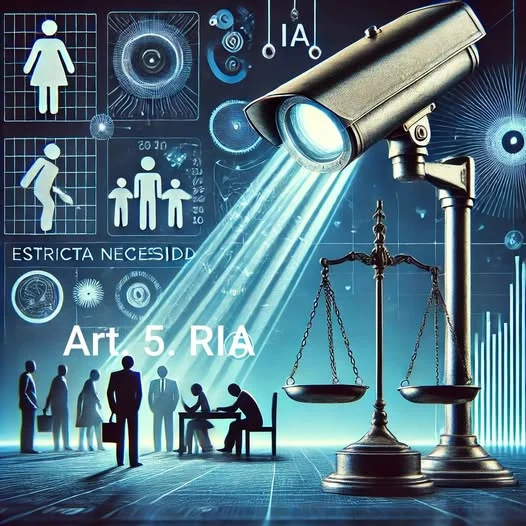
regulation of artificial intelligence in the European Union has been presented as a pioneering effort to guarantee that technological development respects fundamental rights. However, when analyzing the Article 5 of the EU AI Regulation , a legitimate concern emerges: are we really facing a solid protection framework or a regulatory architecture with doors too open to dangerous interpretations?
1. The promise of a prohibition that is diluted in exceptions
At first glance, Article 5 establishes a seemingly blunt prohibition: the use of real-time remote biometric identification systems in public spaces is prohibited. However, this prohibition quickly becomes an ambiguous statement when examining the permitted exceptions. Its use is enabled in cases of:
* Search for missing people, a legitimate justification but with potential risks of abuse.
* Prevention of serious crimes, a criterion that is too broad if the crimes that would fall into this category are not precisely defined.
* Fight against terrorism, a recurring argument that has served in the past to justify invasive surveillance measures.
The essential problem lies in the elasticity of the concept of “strict necessity”, a legally indeterminate term that allows Member States to interpret these exceptions according to their own interests.
When is a threat truly imminent? What does “substantial risk” mean?
Without strict criteria and independent oversight mechanisms, these provisions could end up legitimizing the widespread use of mass surveillance technologies under the guise of public safety.
2. Regulatory ambiguity: a crack in legal security
The language used in the regulations leaves wide margins for discretion. Expressions such as “imminent threat” or “substantial risk” do not have a clear definition, which generates uncertainty for both citizens and the authorities in charge of applying it. In an environment where artificial intelligence is increasingly integrated into government and police decision-making, a lack of clarity can lead to dangerous arbitrariness.
The possible consequences of this lack of precision are worrying:
* Expansion of mass surveillance: without clear limits, States could justify the use of these facial recognition tools in much broader contexts than anticipated.
* Legal uncertainty: since there are no uniform criteria, each EU country could apply the standard differently, eroding the homogeneous protection that community legislation should guarantee.
* Erosion of the right to privacy: the lack of control over the use of biometric identification can lead to ubiquitous surveillance, normalizing a society where each citizen is potentially observed at all times.
3. The role of large corporations: regulation or regulatory capture?
It is important to analyze who has been influencing the configuration of the AI Regulation. Large technology companies such as Amazon, Google and OpenAI have expressed their support for the regulations, but not because it limits their power, but because it allows them to operate within a regulatory framework with sufficient room for maneuver. These companies have advocated for “responsible use” of AI, but in practice they have developed and promoted mass surveillance tools that could benefit from regulatory ambiguities.
In this sense, the regulation runs the risk of becoming an instrument of regulatory capture, where the norm, instead of limiting the power of these companies, ends up legitimizing their influence by establishing a legal framework that facilitates their expansion without real restrictions.
4. Real solution or simple regulatory drill?
For the AI Regulation to deliver on its promise to protect citizens, it is imperative that substantial improvements be made to the oversight and enforcement of its provisions. Some fundamental measures would be:
1. Precise definition of key concepts: terms such as “strict necessity”, “imminent threat” and “substantial risk” must be concrete and leave no room for loose interpretations.
2. Independent control of exceptions: any use of biometric identification in public spaces must be subject to judicial control or to an independent body with real sanctioning capacity.
3. Full transparency in implementation: Law enforcement and government agencies must be accountable for when, how and why they use these tools.
4. Guarantee that regulation does not become a means of mass surveillance: without strict limits, regulations could normalize a state of hyper-surveillance that contradicts European democratic principles.
WE FINISH mentioning that the regulation needs urgent adjustments
Article 5 of the EU AI Regulation reflects necessary regulatory intent, but its execution is weak in key aspects. The exceptions they allow are too broad, the terms used are imprecise and the supervision of their application is insufficient. If the European Union really wants to guarantee the protection of fundamental rights in the era of artificial intelligence, it must correct these defects before the standard becomes another tool of mass control, instead of a shield for citizens.