
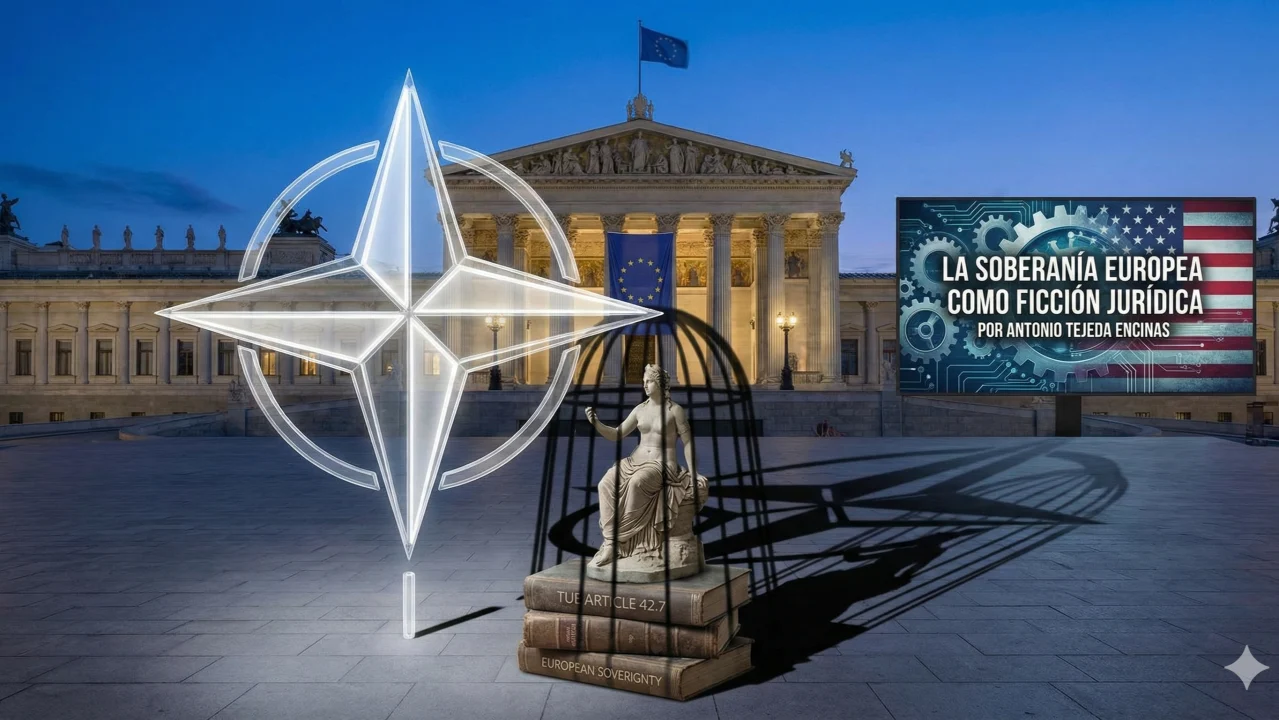
EUROPEAN SOVEREIGNTY AS A LEGAL FICTION: WHY NATO IS THE MECHANISM OF STRATEGIC SUBORDINATION OF THE WEST
By Antonio Tejeda Encinas | Doctor of Law (SJD / Dr. iuris) | Techno‑Geopolitical Analyst | President of CEA Digital Law (Euro-American Committee of Digital Law)
I. The structural diagnosis: NATO as a device for codifying hierarchy
Since 1949, Europe has lived under a comforting illusion: that its collective security rests on an alliance of equals. The North Atlantic Treaty formally established a mutual defence framework that, in principle, placed all parties on an equal footing in the face of a threat. Seventy-six years later, that premise has proved to be a rhetorical construct with no real strategic foundation.
NATO is not a symmetrical alliance. It is a hierarchical system for codifying power, in which Washington occupies the apex of decision-making with no European equivalent. That apex is not merely military, although it is primarily military; it is also technological, energy-related, industrial and, ultimately, political. The United States does not negotiate with Europe within NATO; it informs Europe of strategic decisions that Europeans subsequently ratify, often under the illusion that they took them jointly.
The mechanism works through structural subordination wrapped in the language of cooperation. When Washington decides on extraterritorial sanctions against adversarial geopolitical actors, NATO and the transatlantic framework become the de facto enforcers of that policy, without any prior strategic debate in which European interests carry equal weight. When the United States redefines its industrial policy, from “offshoring” to “nearshoring” and “friend-shoring”, Europe adapts. When it decides that 5G technology requires excluding certain suppliers, Atlantic national security serves as cover for decisions that Europe has not formulated for itself.
None of these cases involves a genuine multilateral decision-making framework. Instead, there is a de facto hierarchy in which the hegemonic power sets the parameters and the European allies, formally “consulted”, fall into line for a simple reason: they have no defence alternative. That lack is not accidental; it is the result of structural political decisions taken over decades.
II. The irresolvable legal contradictions of the Euro-Atlantic order
The European Union and NATO operate in a space of supposed complementarity that is, in reality, an unresolved contradiction. Article 42.7 of the Treaty on European Union establishes an obligation of mutual aid and assistance in the event of armed aggression against a Member State “on its territory”. At the same time, Article 5 of the North Atlantic Treaty sets out an obligation of collective defence within a political-military framework led by the United States.
When both obligations point in the same direction (a clear external adversary, typically Russia), the tension remains latent. But what happens when the vectors cross or could collide? Suppose that Denmark, a member of both the EU and NATO, became embroiled in a territorial sovereignty dispute with an Atlantic power over a strategically sensitive territory. The legal question is simple but devastating: where does the centre of gravity of the response lie, in Article 42.7 TEU or in NATO’s Article 5?
Any honest lawyer knows that Article 42.7 is not a “European Article 5” with its own chain of command, logistical structure and strategic planning, but an essentially intergovernmental assistance clause, organised case by case among Member States and heavily dependent on national choices. Reading it as a miniature NATO is a formalism that is useful in seminars but irrelevant to the realities of power. That is precisely the dysfunction: Europe has given itself a legal obligation of mutual defence without the institutional, logistical and technological muscle that would turn it into an effective guarantee against any threat, including one from a hegemonic ally.
The current debate over whether Article 42.7 applies to Greenland illustrates this with uncomfortable precision. Some scholars argue that any aggression against a territory under Danish sovereignty could trigger the aid and assistance clause; others stress that only territories fully within the scope of the EU Treaties would be covered. The mere fact that European lawyers are debating whether armed aggression against a territory associated with a Member State would fall within the perimeter of mutual defence shows how far “European strategic sovereignty” remains an unfinished category.
The Treaty of Lisbon attempted to remedy this deficit through the Common Foreign and Security Policy (CFSP) and the Common Security and Defence Policy (CSDP). Both have failed structurally: the unanimity requirement on defence makes every step forward hostage to 27 potential vetoes, while NATO, under US leadership, operates on a logic of concentrated political command. In practice, Europe negotiates with itself while Washington acts.
III. Geopolitical redesign and strategic readiness crisis
What has lain dormant for decades is now coming sharply into focus: the post-Second World War order is breaking down. The symptoms are many (the war in Ukraine, tensions in the Indo-Pacific, the debate over Greenland’s strategic status), but they all point to a common reality: the powers are unashamedly redrawing the perimeters of their interests, resources and military reach.
Europe, having entrusted its security to an alliance in which it is subordinate, suddenly finds itself without an autonomous defence. Not because the United States has abandoned it; on the contrary, the US maintains a significant military presence on the continent. That presence no longer reflects a commitment to “defending Europe” in the strict sense, but rather US positioning in the Eurasian competition with Russia and China. Europe is the board on which Washington plays its main games; whether Europe wins or loses is part of the calculation, but does not determine it.
This shift is strategically coherent from the US point of view. The United States has global interests; Europe has European interests. When those interests coincide, NATO serves as a mechanism for legitimising decisions taken in Washington. When they diverge, NATO becomes a forum in which US priorities prevail and European ones are sidelined. No symmetry is possible when one party can unilaterally define the perimeter of the threat and the other depends on it for its own defence.
Moreover, geopolitical redesign has a technological dimension that can no longer be relegated to a footnote. Control of the technological perimeter (critical infrastructure, data, semiconductors, cyber defence) is now as important as control of physical territory. Through its corporations and its regulatory tools (extraterritorial sanctions, export controls, investment screening), the United States shapes which European technologies can be developed, with whom they can cooperate and under what restrictions. Atlantic security is used to legitimise these decisions.
Europe, in other words, uses NATO to subordinate itself: it describes as cooperation an arrangement in which it has outsourced to a third party the definition of its risks, its technological allies and its industrial limits.
IV. The paradox of mutual defence in a hierarchical order
There is a question that no European institution has answered honestly: what does “mutual defence” mean when one member of the alliance is a global hegemon and the others are regional powers of limited capability?
The theory of collective defence rests on a premise of relative symmetry: proportional contribution, shared benefit and a common external threat. But in Atlantic practice, the threat is defined in Washington. When Russia is the priority, European funds are directed to the eastern flank. When China moves up the US agenda, NATO begins to pivot rhetorically towards the Indo-Pacific, even though most European states have no real capacity to project power into that theatre.
What makes genuine “mutual defence” structurally impossible is that, in the event of a direct conflict between the United States and another NATO member, there is no institutional mechanism that would allow Europe to act as arbiter or counterweight. The design codifies subordination: Washington decides; the rest carry out or abstain.
V. The unseemly question: can NATO protect Europe from the United States?
This is the question that official discourse avoids, but that any serious geopolitical analyst must ask: is there any mechanism within the Atlantic architecture that would allow Europe to defend itself against aggression, pressure or strategic imposition from the United States?
The answer is clear: NO. The North Atlantic Treaty does not even contemplate the possibility that the hegemonic power might act as an aggressor against an ally’s vital interests. This is not a gap; it is by design. NATO was built to allow Washington to act with the legitimacy of a collective alliance, not to give Europeans the tools to restrain it.
Let us take the logic to its extreme to show how fragile the system is. If a US president decided that Greenland’s strategic resources, or the geographical position of Ceuta, Melilla or the Canary Islands, were essential to US national security, to the point of justifying extreme pressure or even the use of force, what could Europe do? Invoke NATO’s Article 5 against Washington? Inconceivable. Activate Article 42.7 TEU as the basis for organising a European defence against the ally? Conceivable in theory; politically suicidal.
The reason this scenario has not materialised is not the solidity of the legal framework, but a temporary convergence of interests. That convergence is not structure; it is circumstance. And circumstances change.
VI. Towards autonomous European defence: a need that cannot wait
Europe needs, with an urgency that no longer leaves room for evasive rhetoric, an autonomous defence capability that does not depend on the will of the United States. This does not mean leaping into the void by leaving NATO overnight (that would be strategically reckless), but it does require building, in parallel, a military, technological and industrial structure that can function without the Atlantic umbrella.
That means, in concrete terms:
- Genuine European military integration that moves beyond the current patchwork of national armies towards common command, planning and deployment capabilities.
- A strategy for technological autonomy in semiconductors, artificial intelligence, cyber defence and data control that reduces dependence on US infrastructure and platforms.
- An energy policy that minimises vulnerability to sanctions decisions taken by others, whether by the United States or by third countries, and that is aligned with a European security design rather than a subordinate one.
- A regulatory and operational architecture that places Article 42.7 TEU at the top of the decision-making hierarchy as the highest expression of European defence, rather than as a footnote to NATO’s Article 5.
None of this is possible while the European Union remains trapped by unanimity on defence and by the political comfort of Atlantic tutelage. France has understood this since De Gaulle; Germany is beginning to sense it; the rest of the continent wavers between unease and inertia.
VII. The deferred choice: sovereign power or administered territory
Europe faces a choice that is not technical but existential: whether it wants to be a sovereign actor in history or to resign itself to being a territory administered by an external power under the reassuring narrative of “collective defence”.
NATO, in its current form, makes the first option unviable. Not because American intentions are necessarily predatory, but because the institutional architecture codifies a hierarchy that rules out symmetry. As long as Europe delegates its defence to Washington, it will also be delegating its foreign policy, its technology policy and, ultimately, its own sovereignty.
Thinking about a post-NATO horizon is not an exercise in anti-Americanism; it is an exercise in strategic maturity. Europe must equip itself with an autonomous defence capability that allows it to cooperate with the United States as an equal rather than from a position of dependence. Only then will the European Union cease to be a sophisticated legal fiction and begin to exist as a full subject of the international system.