
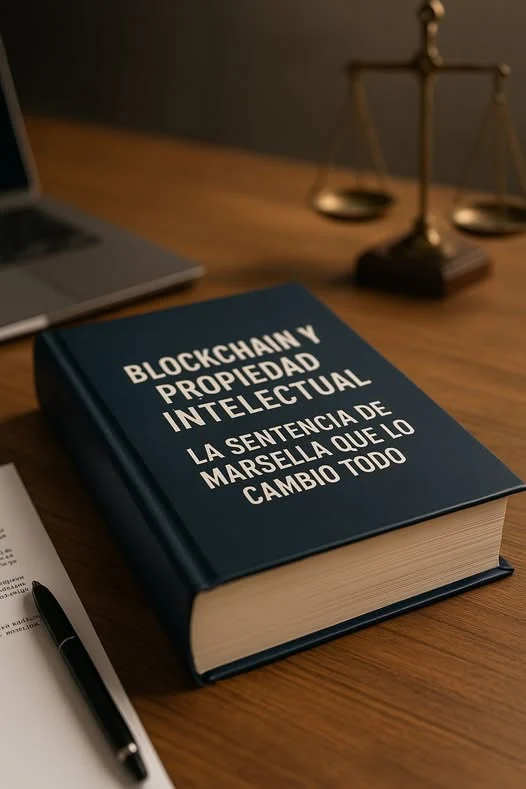
The ruling of the Marseille Judicial Court that surprised us was handed down on March 20, 2025 and corresponds to the case AZ Factory against Valeria Moda.
In this litigation, AZ Factory accused the French company Valeria Moda of infringing copyright by marketing garments that reproduced the original characteristics of its “Love from Alber” and “Hearts from Alber” designs.
The court recognized the evidentiary validity of the blockchain records presented by AZ Factory, establishing that the ownership of the copyright over the aforementioned garments was demonstrated by the blockchain date records of May 5, 2021 and September 15, 2021.
As a result, Valeria Moda was convicted of copyright infringement and ordered to pay damages to AZ Factory to compensate for the harm suffered.
1. Introduction
The legal recognition of technological evidence has undergone constant evolution over the last decades. However, the recent ruling of the Tribunal Judiciaire de Marseille of March 20, 2025 marks a turning point that forces us to rethink the foundations on which the evidentiary status in matters of intellectual property is based.
In this case, which pitted the firm AZ Factory against the French company Valeria Moda, the court addressed the issue of copyright infringement on designs registered on the blockchain. What was relevant was not only the admission of the hash as proof of priority, but also that it attributed the ownership of the copyright exclusively by virtue of the registration in the blockchain. There was no prior official record or additional contractual documentation. Only technological evidence, apparently objective, automatic and external to any public entity.
At first glance, the ruling can be interpreted as a gesture of legal modernization: a courageous opening towards the recognition of new forms of digital documentation. But beneath that appearance of progress lies a deep-seated structural tension. Because if a court can confer subjective rights with full legal effects from a mere blockchain hash—without institutional contrast, without expertise on its legitimacy, without prior public registration—what is at stake is not only the acceptance of new evidentiary technologies, but the displacement of the very system of guarantees that supports legal certainty in the attribution of rights.
Are we, therefore, facing a simple evidentiary evolution or a doctrinal rupture with unforeseeable consequences?
Is blockchain qualified and sufficient proof to establish the existence and ownership of intellectual rights?
Or are we giving in to technological fascination without properly examining the legal implications that this entails?
This structural legal analysis aims to address these issues from a critical perspective, analyzing the real value that can – and cannot – be given to blockchain-based evidence in the framework of copyright and, in particular, in its confrontation with the classic registry principles that guarantee opposability, traceability and legal security.
2. Technical and legal foundations of blockchain-based proof
In the evidentiary field, one of the essential functions of digital technology is the certification of the temporal moment of creation or existence of content, known as timestamping. This mechanism makes it possible to precisely set a certain date, generally with a guarantee of integrity, on a certain document, file or creative expression. The use of blockchain in this context has been received by many as a disruptive innovation, capable of replacing or at least competing with classic electronic certification systems. But what is really behind this alleged superiority?
2.1. The hash as an evidentiary anchor
The evidence presented in the French case consisted of a hash—a cryptographic fingerprint generated from a digital file—registered on a public blockchain, with a verifiable time stamp. The fundamental property of the hash is that it is a one-way function: any alteration of the original content generates a completely different fingerprint. This allows us to ensure that the corresponding file existed on a certain date and has not been modified since then.
However, the hash does not identify the author or the right holder, nor does it on its own prove the creation process, nor does it establish a legally binding connection between the person who generated it and the protected content. This is, ultimately, proof of existence and integrity, not of authorship or subjective rights. Therefore, its value as attributive evidence of ownership is limited, unless it is accompanied by other elements of evidence or a presumption in its favor is admitted.
2.2. What differentiates blockchain from other electronic certification systems?
In legal practice, there are numerous mechanisms prior to the use of blockchain that allow proving the existence, date and integrity of digital documents:
Trusted electronic service providers qualified under the eIDAS Regulation (such as Logalty, eGarante, Signaturit, among others).
Electronic notarizations.
RFC 3161 time stamps issued by recognized authorities.
Certified email, digital acknowledgment of receipt or reliable delivery platforms.
The most notable difference between these systems and blockchain is that the former depend on a trusted third party, while blockchain operates on a decentralized system where, in theory, there is no single entity that can manipulate the record. This has led to blockchain being considered to offer a superior form of immutability, traceability and fraud resistance. But this decentralization does not guarantee, by itself, the evidentiary reliability or legal validity of the data, especially if:
The blockchain is not auditable, verifiable or its code is not open.
The hash insertion process is not linked to a qualified electronic identity.
There is no chain of custody between the author and the registered content.
23. The eIDAS 2 Regulation and the status of electronic ledgers
Regulation (EU) 2022/0240, known as eIDAS 2, in an advanced phase of implementation, introduces for the first time a legal definition of the concept of electronic ledger (electronic accounting book), explicitly including blockchain. The standard establishes that:
“An electronic ledger will not be denied legal effects or admissibility as evidence in judicial or administrative procedures for the mere fact that it is in electronic format or does not meet the requirements to be considered qualified.”
However, only electronic ledgers managed by qualified providers may benefit from the presumption of integrity, accuracy and chronological order in accordance with art. 45g of projected text.
Therefore, within the framework of eIDAS 2:
Any electronic ledger is admissible as evidence, but
Only those qualified enjoy a reinforced presumption (iuris tantum) about its veracity.
This point is essential to understand why the Marseille ruling represents a doctrinal break: the court grants substantive effects to a hash in the blockchain without requiring qualification of the ledger, nor qualified identification of the author, nor direct legal connection with the content.
3. Critical analysis of the sentence: between evidentiary innovation and risk of legal destructuring
The ruling of the Tribunal Judiciaire de Marseille represents, without a doubt, an unprecedented step in the recognition of blockchain as evidence in the field of intellectual property. But what is really new—and legally disturbing—is not that a hash registered in a blockchain has been accepted as valid evidence, but rather that said evidence has been considered sufficient to attribute ownership of a copyright, without the existence of an official record, contract, testimony or any additional evidence.
3.1. From proof of fact to attribution of law: a qualitative leap
Traditionally, the value of evidence in copyright matters has been understood in terms of procedural evidence: it is about proving that content existed on a certain date and under certain conditions. But in this case, the court has gone one step further: it has considered that the technological evidence is sufficient to legally declare who is the owner of the subjective right over the design in dispute.
This represents a qualitative leap that is not without risks, because it converts a technical evidentiary instrument into a direct source of legal legitimation, without institutional support or contrast with other security mechanisms.
3.2. The absence of registration as a breaking point
In most legal systems, registration in official records does not constitute copyright, but it does act as a guarantee of publicity, traceability and enforceability. Therefore, although ownership arises with creation, the most solid and universally recognized proof continues to be registration in national or international intellectual property registries.
The judicial decision in question breaks with this system logic, by declaring ownership on the basis of a private and unregulated technological test, opening the door to scenarios of legal uncertainty:
What would happen if someone else presents a different, but older, hash on another blockchain?
What legitimacy does a non-auditable chain have, without institutional verification or identity guarantee?
What if the file linked to the hash itself was plagiarized, and the hash is simply proof of ownership, not authorship?
The court, by ignoring these issues, shifts the burden of proof to the defendant, in practice reversing the principle of presumption of innocence in the civil sphere.
3.3. Presumption of legitimacy without institutional control
One of the most controversial elements of the ruling is the implicit acceptance of a presumption of legitimacy derived from the mere existence of the hash in the blockchain. The court seems to understand that, in the absence of evidence to the contrary, this technical evidence is sufficient to attribute the right, which means granting attributive and not just indicative value to a tool that, by its very nature, does not verify identities or control legal intentions.
On a comparative level, this position departs from the prudent trend of other jurisdictions, which admit blockchain as a means of proof of facts, but not as an exclusive basis for legal attribution. In systems such as the German, Spanish or Canadian, the general rule remains that proof of authorship requires a set of converging evidence, among which blockchain can play a relevant, but never exclusive, role.
3.4. A risky precedent in times of legal hyper-technologization
The main risk of this ruling does not lie in the use of blockchain, but in the principle it enshrines: that a private technology, without official auditing or qualification, can replace the traditional function of registration law or structured judicial evidence.
This generates a precedent that can be misinterpreted or exploited by economic operators, technological platforms or individuals who, with access to blockchain tools, could present themselves as rights holders with no more support than a unilaterally generated hash.
4. The principle of legal certainty and its fragility in the face of technological disintermediation
The French ruling that recognizes attributive effects to a test based exclusively on blockchain, without prior registration or institutional verification, raises a fundamental question that transcends the evidentiary: can legal certainty be maintained if the rights attribution system is fragmented into multiple private technologies, unaudited and without public control?
The principle of legal certainty, enshrined in most modern constitutional texts (art. 9.3 Spanish CE, art. 1 of the French CC, art. 1.1 of the Italian Constitution, among others), requires that legal rules and procedures be predictable, stable and accessible, so that citizens and economic operators can foresee the legal consequences of their actions.
This principle is not limited to the formal guarantee of legality, but rather fulfills a structural function of balance between individual freedom, legitimate trust and normative order. In this sense, Registry Law—both in its public dimension and in its procedural aspect—has historically been one of the pillars of said stability, offering:
Advertising to third parties.
Presumption of legitimacy of the registered owner.
Legal traceability of rights.
And, in many cases, international coordination through interoperable treaties and registries.
By replacing this model with private registries – such as public or semi-private blockchains – managed outside of any institutional system, a technological disintermediation of the Law occurs which, if not regulated, weakens its own constitutional foundations. This fragmentation, although driven by innovation, runs the risk of generating:
Plurality of evidentiary truths, without clear hierarchical criteria.
Ownership conflicts cannot be resolved ex ante, but only through litigation.
Uncertain opposability, especially in cross-border relationships or in environments without qualified digital identity.
Furthermore, the principle of equality in access to effective legal protection (art. 24 EC, art. 6 ECHR) could also be violated if the legal validity of a piece of evidence is subject to the economic or technical capacity to access a certain blockchain solution, depriving other operators of equivalent but more accessible tools.
In this context, it cannot be ignored that Law has a guaranteeing function that cannot be delegated to technological systems, no matter how efficient they may seem. The idea of replacing legal procedures, public records or official certifications with decentralized technologies cannot be justified for reasons of efficiency or speed, if this undermines the common legal protection framework.
What is at stake is not only the value of evidence in a specific litigation, but the regulatory model on which the protection of rights in the digital age is built.
5. Proposal for an integrative framework: harmonization between evidentiary technology and institutional guarantees
If technological advancement poses challenges for the Law, the solution is not to ignore innovation, but to integrate it into a regulatory framework that preserves the structural principles of the legal system. The recognition of blockchain as a means of proof—and even as an attribution tool in some contexts—does not have to imply the erosion of legal security, as long as clear regulatory criteria, institutional interoperability and verifiable control mechanisms are established.
5.1. Blockchain as a complementary tool, not a substitute
The first step is to redefine the role of blockchain in the evidentiary ecosystem: not as a substitute for official records nor as an autonomous and self-sufficient proof of ownership, but as an additional element of technical proof, useful to reinforce already existing evidence or anticipate its preservation in the event of future disputes.
In other words, blockchain should be understood as an instrument of documentary reinforcement, not as an original source of rights nor as an exclusive presumption of authorship.
5.2. Qualified providers and audited records: towards a European legal standard
The entry into force of the eIDAS 2 Regulation offers a strategic opportunity to establish a common standard in the legal use of distributed technologies. Specifically, it could be promoted:
The creation of blockchains audited and certified by qualified providers of trusted electronic services, subject to verification and interoperability within the European market.
The integration of qualified digital identity systems (eIDAS) that allow the hash to be linked to an officially recognized natural or legal person.
The registration of these acts in public or mixed meta-registries, with traceability and institutional integration.
This approach would ensure the reliability of the tests, without giving up technological efficiency or the automated traceability of distributed systems.
5.3. Interconnection between blockchain and official records
A realistic and technologically viable legal path is the interconnection between blockchain and public registries, so that:
Registrations in blockchain may have reinforced evidentiary value if they are validated by the registry system.
Public registries accept evidence generated in blockchain as valid evidence, as long as it meets certain technical, identity and integrity requirements.
An evidentiary chain of custody recognized by the judicial system is established, which makes it possible to prove the authenticity of the content and its connection with the owner of the right.
This formula would allow taking advantage of the efficiency of technology without giving up the legal guarantees of registration law, configuring a hybrid and secure ecosystem.
5.4. A new framework for the digital evidentiary ecosystem
The solution is not to choose between the classic model and technology, but to build an intermediate model of evidentiary governance, based on:
Common standards for evidentiary digital interoperability.
Technological and institutional audit.
Mutual recognition of verified digital evidence, at least at the European level.
This framework would allow us to respond to the challenge posed by the Marseille ruling without falling into technological maximalisms or legal anachronisms, and would convert the disruptive potential of the blockchain into an opportunity to reinforce the digital Rule of Law.
6. To finish
The ruling of the Tribunal Judiciaire de Marseille of March 2025 marks a before and after in the legal use of blockchain as a means of proof in matters of intellectual property. Its pioneering character lies not only in the recognition of the chronological value of a hash, but in its decision to directly attribute the ownership of a subjective right on the exclusive basis of that technological proof, without prior registration or institutional verification.
This precedent, although innovative, questions the fundamental pillars of legal security, by displacing the evidentiary value of the institutional system towards technological solutions that are not regulated or audited. Attributing rights based on private records, without public control mechanisms or verifiable legal traceability, opens a scenario of regulatory fragmentation and structural insecurity that the Law cannot ignore.
Blockchain technology offers real advantages: immutability, traceability and efficiency. But its potential must be channeled legally, not elevated to an autonomous source of legitimacy. The current challenge is not technological, but regulatory: how to incorporate these tools within a guaranteeing, interoperable evidentiary ecosystem subject to the principle of legality.
Faced with the temptation to replace classic systems with decentralized solutions, the legal response must be integrative. Technological innovation cannot weaken the institutional architecture of the Rule of Law, nor displace the registration system as an instrument of publicity, protection and legal security.
Therefore, it is essential to move towards a hybrid model, where blockchain can play a complementary role within a regulated framework, linked to qualified providers, with digital identity certification and institutional verification. Only in this way can it be guaranteed that the technological revolution does not erode the structural principles of the legal order, but rather reinforces them and projects them towards a fair, secure and coherent digital future.