
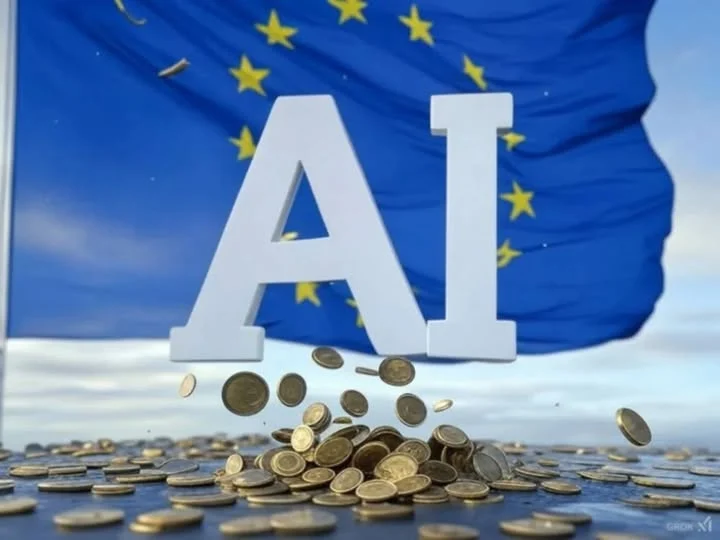
Continuing with the Artificial Intelligence (AI) Action Summit in Paris, 10–11 February 2025
Europe has decided to bang its fist on the table, with €200 billion. Through InvestAI (announced at the Paris summit), the European Union intends to throw itself fully into the global artificial intelligence (AI) race.
It is an ambitious bet: home-grown infrastructure, European talent and technological development aligned with EU values. Once the initial euphoria has passed, however, the criticism needs to be forceful. (I’ll play good cop another day.)
 Can this investment really turn Europe into an AI leader, or is it just a belated reaction with no solid foundations?
To answer that, we need to look at what it really takes to lead in AI and whether Europe has it.
 1. Can money close the gap with the US and China?
Leadership in AI is not bought; it is built on technological infrastructure, access to data, talent and strategic regulation.
Compare Europe with its competitors and the differences are plain to see.
 United States: innovation without restrictions
 Absolute hardware dominance: Nvidia, Intel and AMD control the production of advanced chips. A private ecosystem without red tape: investment flows freely, without heavy regulation. Concentrated data and talent: OpenAI, Google and Microsoft have access to the best experts and vast amounts of data.
 China: massive investment and market control Home-grown semiconductor manufacturing and strong state backing for giants such as Alibaba and Baidu. Unlimited data access thanks to an unrestricted digital ecosystem. A long-term strategy aligned with its industrial and military interests.
 Europe: technological dependence and strict regulation
 It does not make its own chips and depends on Nvidia and AMD. It lacks large-scale access to data because of restrictive privacy rules. Excessive regulation that slows down innovation compared to its rivals.
 This raises the first big question: how does Europe intend to compete if it remains technologically dependent on its rivals?
 2. Structural problems that limit the impact of investment
 2.1. AI gigafactories without their own chips
The AI gigafactories announced under InvestAI have been presented as a major step forward,
 but without European semiconductors they have no autonomy whatsoever. Without a chip industry of its own, any European AI model will remain tied to foreign suppliers. A telling example: the US has restricted exports of advanced chips to China. What would happen if it decided to do the same to Europe in future?
 2.2. AI without access to big data
AI Act rules prevent models from being trained on large volumes of data, limiting their ability to compete with OpenAI or Google.
For example, while the US trains models on data from thousands of platforms, in Europe data collection is restricted by privacy rules and individual consent.
Without data, there is no competitive AI.
 2.3. Regulations that slow down innovation
While the US and China advance without restrictions, the EU imposes complex regulations that slow down the development of new AI models.
The AI Act imposes barriers that US and Chinese companies do not face, limiting the ability of European start-ups to scale.
2.4. Internal fragmentation in the EUEach country has its own AI strategy, which complicates coordination and uniform access to funds and infrastructure.
France, Germany and Spain, for example, have each adopted their own AI strategies, with national funding and different priorities:
France is betting on digital sovereignty and generative AI, with large investments in supercomputing. Germany prioritises industrial and manufacturing AI, building on its leadership in automation. Spain has focused its strategy on ethical AI and the digitalisation of SMEs.Whereas companies in the US and China grow under a single regulatory framework, in the EU they have to navigate 27 different sets of rules.
 3. Where does the money really go?
The €200 billion investment is substantial, but it is poorly targeted.
 Infrastructure? Without its own chips, it will be dependent on the US. AI models? Without access to data, they will not be able to compete with OpenAI or DeepMind. Talent? Without attractive conditions, European experts will keep leaving for Silicon Valley.
 Investing without addressing these deficiencies is like building a skyscraper on sand.
 4. What should Europe do to avoid wasting this investment?
The key is not just spending money but building a sustainable technology ecosystem. To that end, Europe needs:
 4.1. Semiconductor autonomy Urgent investment in home-grown chip production so as not to depend on the US and Asia. Encourage European companies such as ASML (a Dutch company and the only one in the world capable of manufacturing extreme ultraviolet (EUV) lithography machines) to develop AI-specific processors.
 4.2. Access to data without compromising privacy Make the AI Act more flexible to allow more advanced AI training without compromising privacy. Put in place agreements within the EU for the ethical sharing of data between EU countries.
 4.3. Nurture talent and prevent brain drain Offer tax incentives and better conditions to retain European researchers. Develop AI research centres with globally competitive salaries and resources.
 4.4. Unify the EU’s AI strategy Eliminate fragmentation and establish a single regulatory framework for AI across Europe. Simplify bureaucratic processes to attract investment and facilitate the growth of technology startups.
 5. Strategic investment or a failure foretold?
Europe has bet big, but unless it addresses its structural weaknesses, InvestAI risks becoming an initiative with plenty of money and little real impact.
 The €200 billion will be of no use if Europe continues to depend on the US and China for hardware, limits access to data and imposes regulatory barriers that stifle innovation. The investment is necessary, but without a strategy it will be money spent with no return.
 Key questions that will define the future of AI in Europe
Will Europe be able to manufacture its own chips to guarantee its technological independence?
Will the EU review its regulatory framework so as not to stifle innovation?
Can it really compete with the US and China or is it destined to be a secondary player in global AI?
Last chance or strategic suicide?Europe is gambling not only with its technological leadership but with its geopolitical sovereignty. Investing €200 billion without resolving its dependence on chips, data and talent is not just a mistake: it is strategic suicide.
If InvestAI fails, the EU will face a future in which it loses not only the technology battle but also its economic and political autonomy. This is not just about AI; it is about whether Europe will be a digital power or be reduced to a technological colony, destined to write the rules for technologies it will never be able to control.